
On November 5, crypto market volatility continued and Bitcoin fell to $99,000, falling below the important psychological level of $100,000. Bitcoin's price decline was fueled by growing fear, the aftermath of the October 10 liquidations, waning institutional interest, and selling by long-term holders (LTHs), among other factors. However, Bitcoin previously managed to bounce back to $101,000 despite the recent crash.
Bitcoin Price Trajectory on November 5th
At the time of writing, BTC is trading above $101,000, down 2% in the last 24 hours. Earlier, the price of BTC dropped to $99,000 before a slight recovery to current levels.
BTC USD Price Today BUY BTC The overall crypto market continues to show volatility and is down over 1.8% today with a market cap of over $3.38 trillion. The Fear and Greed Index currently indicates Fear, approaching extreme fear levels.
Causes of Bitcoin Price Fall
Since its last all-time high, BTC is down about 20%, and what was supposed to be «Uptober» has turned into a «Red October». Bitcoin's decline from its new high of over $126,000 hit on October 6 is due to several factors, including selling by long-term holders.
BTC sales of LTHs
On November 5, citing Vetle Lunde, head of research at K33, Bloomberg pointed out that more than 319,000 BTC, currently valued at more than $32.4 billion, had been reactivated in the past month, most of which came from LTHs. Long-term holders are entities that have held BTC for between six and twelve months. The move suggests the whales have cashed in, and while some of the recovery comes from internal transfers, much of it reflects actual selling. In a post on X on November 4, Lunde also mentioned that BTC's 30-day performance against the Nasdaq was the weakest since the summer when Germany decided to sell its BTC holdings.
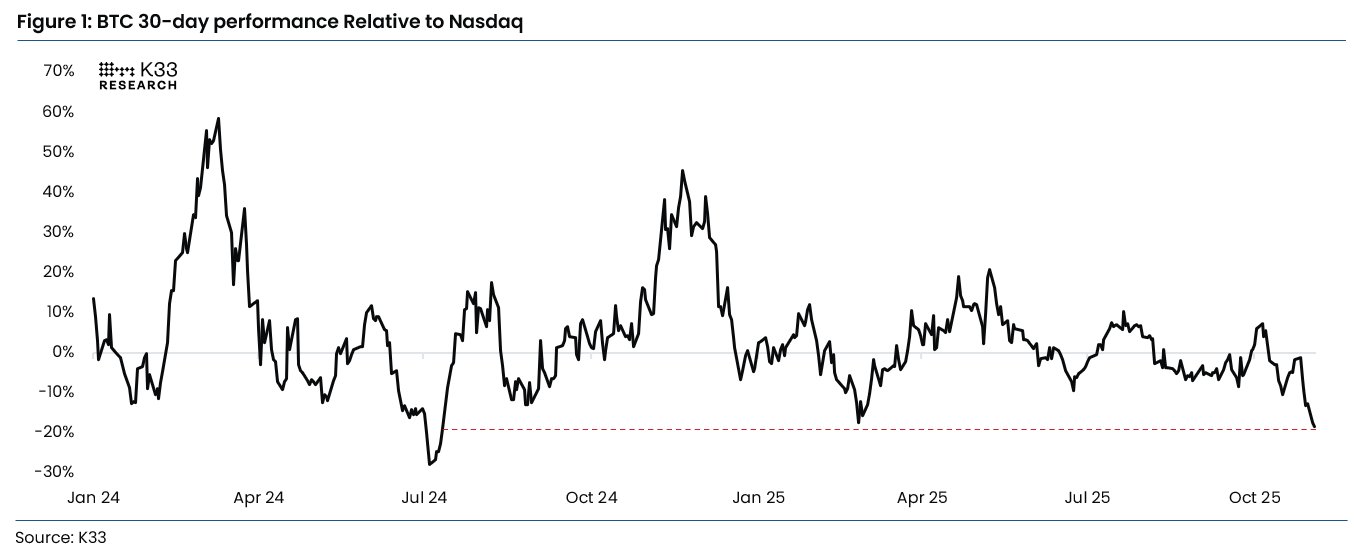 BTC 30-day performance vs. Nasdaq – K33 data The latest sell-off in LTHs reflects a sad event, Bloomberg noted – the erosion of conviction. The publication also quoted Markus Thielen, head of 10x Research, who said that there is a growing imbalance between LTHs selling BTC and new investors. Thielen noted earlier in 2025 that «mega whales,» entities holding between 1,000 and 10,000 BTC, began selling just as institutional players were trying to absorb the supply through inflows into BTC ETFs. This is how he explained BTC's price trajectory over the summer. In the last month, LTHs have sold around 400,000 BTC, currently valued at over $40 billion. After the Oct. 10-11 crash, overall demand fell and people had to close their positions, according to Thielen.
Liquidations in the crypto market
After the massive crypto liquidation event on October 10–11, traders continued to use leverage, leading to further liquidations in the market. Over $1.72 billion in crypto positions were liquidated in the last 24 hours, with $1.31 billion in long positions and over $406 million in shorts.
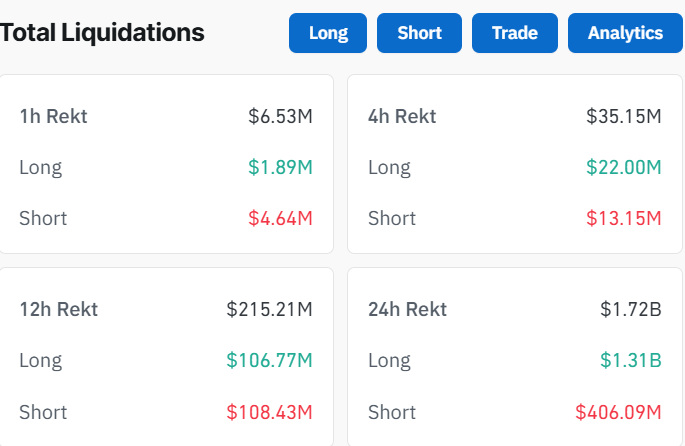 crypto liquidations – CoinGlass data Over 438,700 traders have been liquidated, according to CoinGlass data, with the most liquidations in the last 24 hours occurring on Bybit, followed by Hyperliquid and Binance. However, in the last 24 hours, ETH saw the highest number of liquidations, over $572 million, followed by BTC with over 492 million.
Exits from BTC ETFs
Institutional interest in BTC has waned, and US BTC ETFs have seen outflows for five consecutive days since October 29. According to SoSoValue data, the biggest day of outflows was on November 4, when crypto products saw outflows of more than $577.7 million.
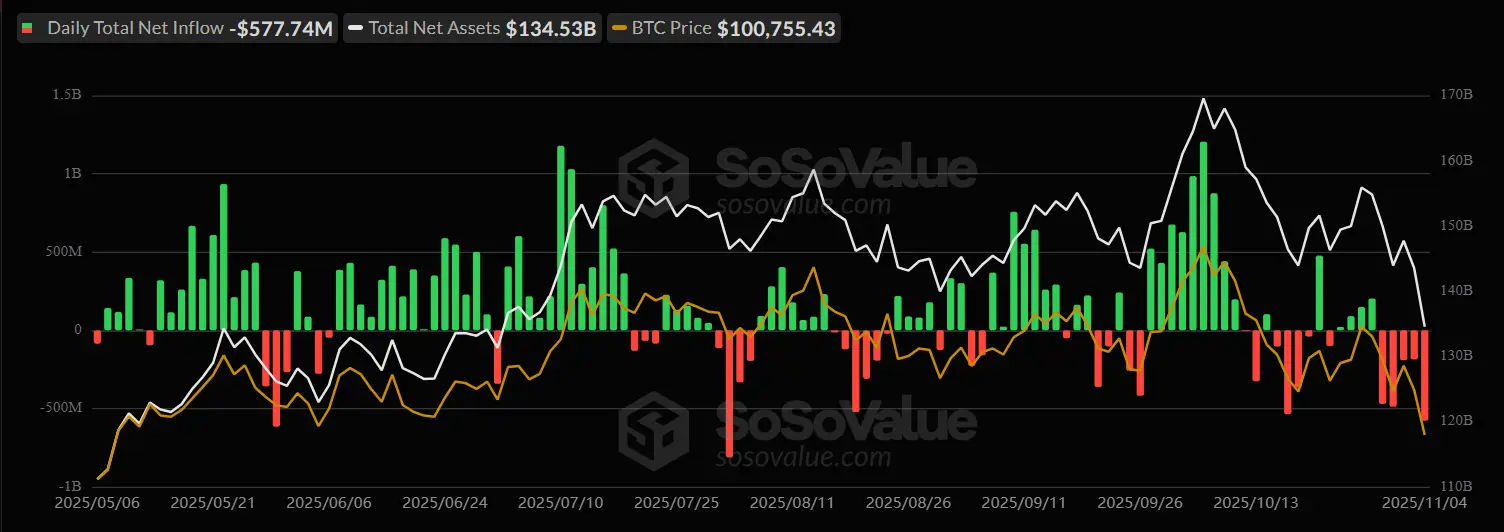 BTC ETF Flows – SoSoValue Data Institutional interest has shifted from both BTC and ETH to Solana, as shown by the six consecutive days of inflows into SOL ETFs launched on October 28-29 in the US.
The DeFi crisis
Several DeFi protocols have suffered losses of hundreds of millions recently, including Balancer, Stream Finance and others. These events also led to lower confidence in the industry and massive sales.
What's next for BTC and crypto
Optimism should remain alive in the crypto industry at the end of 2025, as there are plenty of reasons for an optimistic future and a new period of growth for BTC and the markets. After the whale sell-off and multiple market corrections, Bitcoin's upward trajectory should resume. After a dip below $100,000 on November 5, BTC managed to bounce back above this important level. Today marks one year since the US election, and despite the recent 20% drop from its new all-time high, Bitcoin is up nearly 50% from the same day in 2024. The Trump administration has done what the US president originally promised for the industry by implementing more favorable crypto regulation. Trump even pardoned CZ last month, and his administration has emphasized that the «days of crypto persecution» are over. Tensions between the US and China have also eased, which is good for the industry as a whole. At the last US FOMC meeting, the Fed announced the end of QT on December 1st. Despite uncertainty over another rate cut this year, the end of QT is a positive signal for markets. More importantly, Bitcoin and the entire crypto industry continue to see increasing global adoption. Today it was reported that Switzerland has established its own Bitcoin Treasury company called Future Holdings – a highly optimistic signal for the European crypto ecosystem. Future has raised $35 million in funding to bridge Bitcoin and traditional finance. Crypto adoption in Europe is on the rise, and the implementation of a Bitcoin Treasury is a sign of hope for the region. All of these are clear signs that trust in Bitcoin is far from lost – on the contrary, it is quietly growing globally. Jordi Visser, Founding Managing Partner of Anchor Point Asset Management – a global macro hedge fund – and former Managing Director at Morgan Stanley, recently published an important analysis entitled «Bitcoin's Silent IPO: Why This Consolidation Isn't What You Think», in which he addresses the silent liquidity event that is transforming Bitcoin's holder base and strengthening its future stability. In his notes, Visser explains why we are not in a «bear» market and that Bitcoin's current phase represents the IPO the digital asset has never had. Overall, despite the recent crash and volatility caused by multiple reasons, including leverage and massive selling, the Bitcoin ecosystem and the entire crypto industry have not lost their conviction. The ecosystem is maturing and after weeding out the weak, it will continue to thrive and innovation will prevail. Binance's Yi He also gave an optimistic outlook on these recent events, noting that «in every cycle, some exit the market, some leave in tears, and some laugh at the end.» BUY BTC