
Dirty hands. In December 2024, TikTok influencer Haliey Welch, aka Hawk Tuah Girl, launched the memecoin $HAWK, which reached $500 million in minutes before crashing by more than 90% in a few hours. Insiders pocketed tens of millions, leaving 70,000 investors hefty losers, in spectacular crypto scam
This article is brought to you by 21M ⭕, the community of crypto investors behind the 25% Club.
This article contains affiliate links allowing you to support the daily work of the Journal Du Coin teams.
Crypto scam: The shadow behind the millions
The crypto scam economy is a vicious circle: hype, grab, disappearance. She takes advantage of the decentralized and anonymous nature of blockchain : anyone can create a token in ten minutes and raise funds worldwide, without controls. Unlike traditional finance, here there is no policeman who requires a proper file. Result: a complete ecosystem has been set up, with its freelancers, its Telegram groups and its offshore exchanges. According to a 2025 report from Chainalysis, illicit activities only represent 0.34% of the total volume… but that's still 24 billion dollars laundered. The victims? Young people or novices who dream of the next Bitcoin and line the pockets of scammers.
The scam economy in 3 steps
At the heart of the system: the crypto influencers. Charismatic personalities on platforms like X, YouTube and TikTok with hundreds of thousands, even millions of subscribers. They are not simple enthusiasts; many are pros in marketing paid by sponsors and other crypto projects. Their strength? There trust. The self-taught trader who shares his “nuggets”, the blogger who shows off her Lamborghini “won in trades”, the analyst who dissects smart contracts: all build an accessible image. A single tweet or video can significantly influence the price of a token overnight. Problem: behind the enthusiasm, there is often a contract. In 2025, the US FTC recorded +40% complaints against crypto influencers who fail to say that they receive €10,000 to €100,000 per post.
The perfect pump script
In ten minutes, anyone can create a token: funny memecoin or “utility token” which promises the moonmagical AI, automatic returns, NFTs that save the planet. One click, and it's live. The scammer pays a little money to Uniswap or Raydium for the token to appear. Then he opens his address book: micro-influencers (10,000 to 50,000 subscribers) to heat up the community, mega-stars (2 million) for the final explosion. Contract signed in DM, payment in cash or free tokens. The signal falls: “nugget x100”. Discord groups are on fire, TikTok stories are scrolling, coordinated purchases are driving up prices. As soon as the latecomers arrive, the creators and their accomplices empty their bags. The price is collapsing, the influencers have already received their share and are posting the famous “NFA” (not financial advice). Curtain. Scams have many faces: – The classic pump & dump: artificially inflate, then liquidate. – Le rug pull : the creator empties the liquidity pool and disappears (example: QuantumYield, $200 million gone up in smoke in July). – The phishing: fake airdrops that steal private keys. – Ponzi yield farms: 1,000% APY promised, paid… with money from new entrants. They all ride the same psychology: greed, urgency, and the “DYOR” mantra that no one follows when an influencer shouts “moon”.
2025 was rich in business
We will remember 4:
Mars : the SEC dismantles the “MemeMoon Collective”, 15 influencers who pumped $150 million into Solana.
July : QuantumYield, rug pull after fiery lives.
August : In India, police arrest a Bollywood network that was pushing fake “rupee-backed” stablecoins. Results: $100 million gone.
October : the NFT EcoGreen project, sold as a climate savior by Instagram stars, evaporates with $80 million. 70% of the funds end up in the promoters' wallets.
Why does it last?
Because the crypto promise of freedom, of crazy gains, comes up against our flaws: greed, impatience, easy trust. Influencers, in search of views and cash, become the perfect speakers. On the regulatory side, Europe has imposed a mandatory “paid promotion” badge since 2025, but the application is lagging. Scammers are migrating to Africa and Southeast Asia, where influencers' reach goes beyond the radar.
21M's opinion ⭕
21M ⭕ is the crypto investing community behind the 25% Club, a strategy designed to generate a stable return of 25% per year, for 10 years, without active trading.
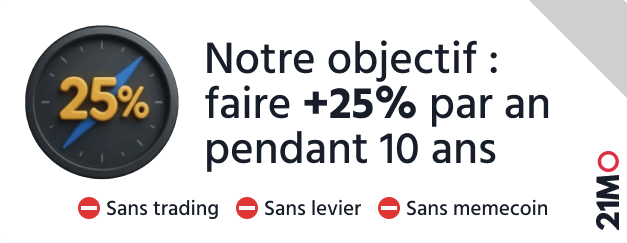
Within the Club 25%we do not rely on “hype”. We grow our capital with measurable, transparent and regular returnswithout depending on the next viral tweet or influencer pump. You have to understand one thing: when you buy a memecoin on the advice of an influencer, you are not investing. You agree to be the “exit liquidity” from someone who got in before you, often the influencer themselves. It's a zero-sum game: for them to win millions, thousands of people have to lose everything. We refuse this game. We are allergic to gurus, media hype and promises of x100 in 24 hours. For what ? Because boredom is profitable.
While the crowd is getting flushed on dog or celebrity tokens, a silent minority of investors are using DeFi (Decentralized Finance) for what it truly is: superior financial infrastructure. Our philosophy is radically opposed to ambient noise:
We are not looking for the “coup” of the centurybut regularity.
We don't bet on speculationbut on the real yield generated by the activity of the protocols.
We aim for 15 to 25% per year on stable assets, with “Good Father” strategies. Does that sound less sexy than turning $100 into $1 million? Maybe. But our members sleep at night. They are building their assets brick by brick, taking advantage of DeFi opportunities without experiencing market volatility.
If you're tired of playing the lottery and want to start running your crypto like a serious business, stop following the noise. Look for the signal.
Want to leave the casino to become your own banker?
Join the investors who have chosen method, safety and sustainable performance.