
What Ciprian Dascălu – BCR, Dragoş Cabat, Aurelian Dochia and Adrian Codirlaşu say – CFA Romania
♦ Nothing that seemed nailed down two weeks ago is no longer relevant. The pillars of the budget, primarily the budget deficit and economic growth, must be redesigned. It is probably too late for this correction to be made in the budget draft, still under discussion by the governing coalition. But as soon as the budget is approved, work must begin on a budget rectification.If the country had a budget, things would have been simpler: this is the budget, conditions have changed, we adapt to them. Now the government is put in the position of adopting a budget that rests on false premises. In other words, to adopt policies that no longer have a counterpart in reality. «The government can continue like this until the middle of the year, but it is obvious that all the conditions have changed. And to restart the discussions now to restore the budget, even before its approval – because it must be rebuilt from the ground up – is extremely complicated», says economics professor Aurelian Dochia. The Gulf crisis is a cluster munition. It hits everything. There are direct and immediate consequences and medium-term consequences. No one knows where the fuel price will stop. Inflation forecasts (3.9% at the end of the year, according to BNR estimates) are no longer valid. The «new» inflation hits consumption – the government was already anticipating, in 2026, a 0.8% decrease in final consumption, but it was betting on a 4% increase in investments. The state must expect higher interest rates on loans, but also a larger deficit of 6.2% of GDP, as it had proposed for this year. «The last forecast we made is from the beginning of this month. We are talking about some scenarios based on data that we can estimate», says Ciprian Dascălu, chief economist of BCR.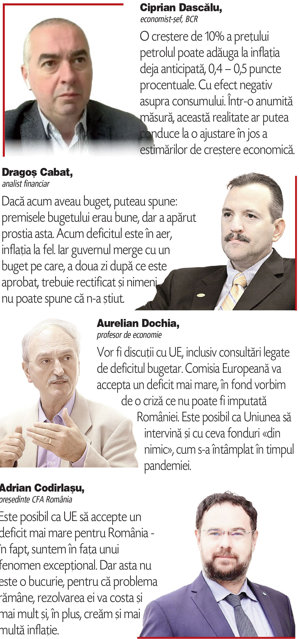 «For example, a 10% increase in the price of oil can add 0.4-0.5 percentage points to the already anticipated inflation. With a negative effect on consumption. To a certain extent, this reality could lead to a downward adjustment of economic growth estimates (1% at the moment – n.d.).» In addition, says the chief economist of the Romanian Commercial Bank, Romania is a net importer of oil and, in general, of energy products, so from the net export side (import minus export) we could see a slightly larger negative contribution, implicitly higher interest rates: «Whether or not we will see a revision of the inflation target depends very much on the duration and intensity of the conflict. If this blockade on the oil market lasts for several months, obviously all prices in the economy that have energy products as input will adjust. Therefore, inflationary expectations will adjust upwards and, at some point, even if we have a supply shock, it will be much less likely to see a reduction in interest rates (at the NBR – ed.) in the second half of this year». The government can approve the budget, but must immediately adjust it. If he approved it a day before the start of the war, he could say: I didn't know. Now, that the approval of the budget will take another two or three weeks, he can no longer say he didn't know, says financial analyst Dragoş Cabat. «If they had a budget now, they could say: the budget's premises were good, but this nonsense appeared. Now the deficit is in the air, so is inflation. And the government goes with a budget that, the day after it is approved, must be rectified and no one can say that they didn't know. But that's not the most serious problem. A project runs on assumptions. The premises no longer correspond, you make an adjustment. The problem here is at the political level – the PSD does not want Bolojan and no longer wants the USR, whose ministers had started rummaging through the cupboards. And the barons got angry», says Cabat. For Adrian Codirlaşu, the president of CFA Romania, the fact that we don't have a budget now is a good thing from the point of view of the budget deficit. «Without a budget, the budget deficit is kept under control, because the expenses are now limited to those made last year. Even with the crisis situation, an expected crisis, but not so early, the deficit of 6.2% of GDP, which the government aims for in 2026, is achievable. That is if no subsidies are given or no other discretionary expenses are made», says Codirlaşu. As for the interest rates that could increase, here the government has no control, because everything depends on extrinsic factors. If the Finances find that, due to inflation, the reduction of consumption, an economic growth below the anticipated one, the deficit target already assumed in Brussels can no longer be defended, what happens? «There will be discussions with the EU, including consultations related to the budget deficit. The European Commission will accept a larger deficit, basically we are talking about a crisis that cannot be attributed to Romania. It is possible that the Union will intervene with some funds «from nothing», as happened during the pandemic. There will be an attempt to save things, the EU will have to intervene because we are witnessing a difficult moment for the Union, itself», says Aurelian Dochia. It is possible that the EU will accept a larger deficit for Romania – in fact, we are facing an exceptional phenomenon. But this is not a joy, because the problem would remain, its solution would cost even more and, in addition, we create even more inflation. The problem remains because debts must be paid. Either you do it today with a cost, or you do it tomorrow with a higher cost, says the president of CFA Romania. Politically, the draft budget is far from being sent to Parliament. PSD announced that it will only meet on Sunday to give its consent to the budget. The governing coalition will meet again today, after an agreement on the budget failed yesterday. Today it is possible for the Finances to put the draft of the consolidated budget in public consultation.
For other news, analyses, articles and business information in real time, follow NV on WhatsApp Channels