
♦ Trade between Romania and the United Kingdom of Great Britain and Northern Ireland increased by 4.9% in 2025, up to 10.3 billion pounds, the highest level in the recent history of the bilateral relationship, according to data from the Department for Business and Trade in London. Romania sells to the British twice as much as it buys from them, the cars produced in Craiova and Mioveni are the most important commodity, and in terms of investments, Vodafone strengthened its top position by taking over Telekom Romania Mobile.
Bilateral trade in goods and services between Romania and the United Kingdom reached 10.3 billion pounds (nearly 12 billion euros) in 2025, up 4.9%, or 480 million pounds, compared to the previous year, according to the latest report published by the Department for Business and Trade (DBT) in London. It is a record level for recent years, with the volume of exchanges almost doubling over the past decade from £5.3 billion in 2016, the year of the Brexit referendum. And 2025 also marked the most important movement of British capital in Romania in recent years: the takeover of Telekom Romania Mobile by Vodafone, one of the largest British investors on the local market. British exports to Romania totaled £3bn in 2025, up 7%, while UK imports from Romania rose 4% to £7.3bn. The result is a trade surplus of 4.3 billion pounds for Romania, one of the few cases in which the Romanian economy has a consistent and persistent surplus in the relationship with an important partner – the British deficit in the relationship with Romania has practically tripled since 2019.
Vodafone, the spearhead of British capital in Romania
If in trade the relationship is pulled up by the car industry, on the investment side the most visible British name in the Romanian economy remains Vodafone, present on the local market for almost three decades. The transaction through which the group with its headquarters in the United Kingdom took over Telekom Romania Mobile, completed in October 2025, had a purchase price of 30 million euros, but doubled by network integration and modernization investments of over 150 million euros announced for the next two to three years – five times the value of the purchase itself. Under the leadership of Nedim Baytorun, CEO of Vodafone Romania, the company is building Romania’s government cloud, has set a target of 65% population-level 5G coverage by 2030 and is preparing for the summer of this year the tests of direct telephone-satellite connections in partnership with AST SpaceMobile – projects that make the telecom operator one of the most concrete technological bridges between the two economies. In the whole of the British trade, Romania occupies the 32nd place among the commercial partners of the United Kingdom, with a weight of 0.5% of the total trade. More relevantly, Romania is the 30th supplier of the British market and only the 46th customer of British exporters. On the goods component, Romania climbs to 24th place among the markets from which the United Kingdom imports. The evolution of the last decade shows a relationship that has withstood successive shocks: after the peak of 7.5 billion pounds in 2018 and the fall to 5.4 billion in the year of the pandemic, bilateral trade has grown continuously – 8.3 billion pounds in 2022, 9.4 billion in 2023, 9.8 billion in 2024 and the record last year.
Cars, the engine of commercial relations
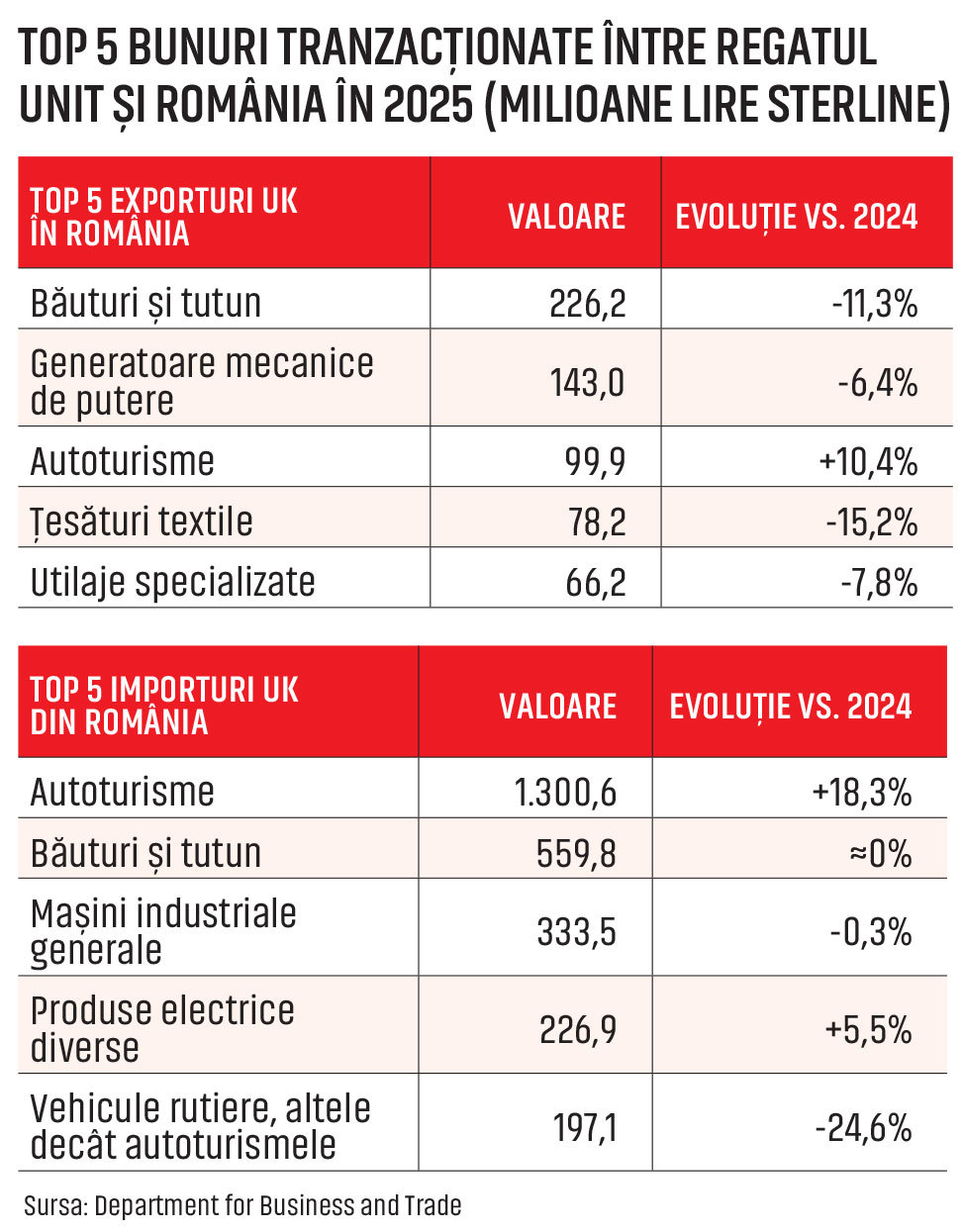
Beyond the aggregate numbers, the trade structure tells the most interesting story, and that’s one about automobiles. Cars are the number one category for British imports from Romania: 1.3 billion pounds in 2025, the equivalent of 30.4% of all Romanian goods sold on the British market, a spectacular increase of 18.3% compared to 2024. Behind this figure are primarily the Ford Puma SUVs produced in Craiova – a model that passed the threshold of one million units manufactured in Romania last month and which for three years is the best-selling car in Great Britain – and the Dacia models assembled at Mioveni, ahead of the Duster, in a market where the Romanian brand of the Renault group has constantly gained ground. The flow also works in the opposite direction, on a smaller scale, but with a much higher symbolic and unitary value. Cars represented the third most important product exported by the British to Romania, with 99.9 million pounds, up by 10.4% – the only category in the top 5 in the plus. This includes the premium and luxury brands that have made the British car industry famous – Land Rover, MINI, Bentley or Rolls-Royce – but also the Nissan models produced in Sunderland, in the largest car factory in the United Kingdom. Basically, Romania sends affordable volume cars to Great Britain, and the British respond with aspirational cars: an exchange that perfectly illustrates the positioning of the two automotive industries.
Whisky-ul, pe podium
The second large category of bilateral trade in goods is equally suggestive. Drinks and tobacco represent the main British export to Romania – 226.2 million pounds in 2025, respectively 15.2% of the total goods, here we find primarily Scottish whiskey and gin, although the category decreased by 11.3% compared to 2024, against the background of a difficult year for consumption in Romania. In the mirror, the same category – beverages and tobacco – is the second Romanian export on the British market, with 559.8 million pounds, more than twice the value of the reverse flow. The rest of the British export list is completed by mechanical power generators (143 million pounds), textile fabrics and specialized machinery, while Romania also sells industrial equipment to the British (333.5 million pounds), electrical products and road vehicles other than cars. In terms of services, tourism dominates both directions. Britons spent 1.3 billion pounds on travel to Romania in 2025, up 6%, while Romanians left 562 million pounds in the UK, 4.3% more than the previous year. Transport – where Romanian carriers are important players on the routes to the island – brought Romania another 543 million pounds, and business services (research and development, consulting, technical services) 636 million pounds. In total, services represent 41.5% of Romanian exports to the United Kingdom and half of British exports to Romania, the segment with the fastest growth: plus 16.1% in a single year. The West Midlands, the heart of the British automotive industry and the region where Jaguar Land Rover and a good part of the supply chain are based, is the largest destination of Romanian goods from the United Kingdom, with imports of 539 million pounds, i.e. 15.2% of the total – another confirmation of the fact that the two automotive industries are closely interconnected.
Investments, the weak link in the bilateral relationship
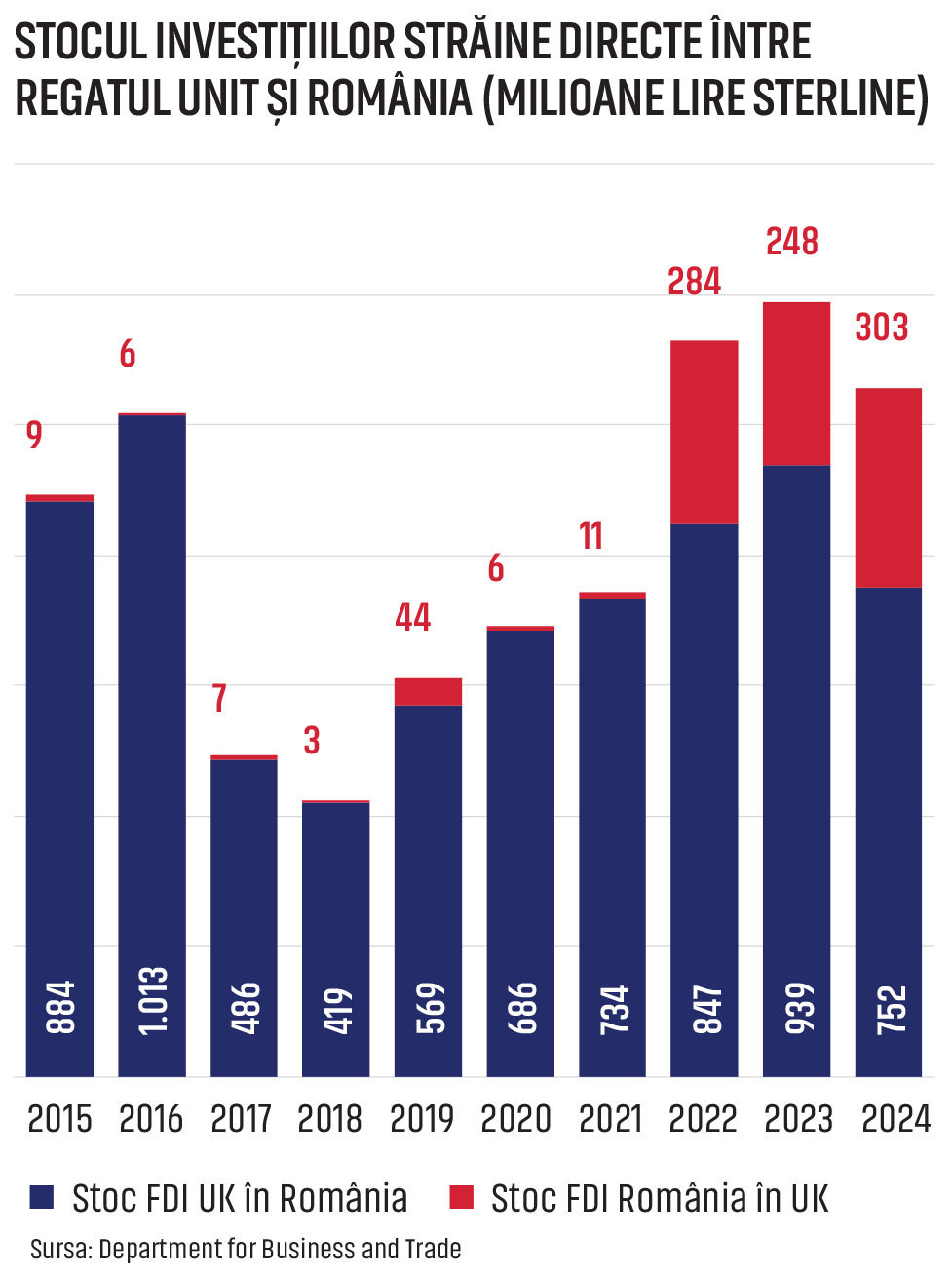
If the trade relationship is at historical highs, the investment chapter remains modest. The stock of British direct investments in Romania was only 752 million pounds at the end of 2024, down by almost 20%, or 187 million pounds, compared to 2023, and below the peak of over one billion pounds reached in 2016. Romania represents less than 0.1% of the total stock of British investments abroad. However, the figures underestimate the real presence of British capital: the ONS statistics are calculated according to the immediate source of the investment, so that British money entering Romania through vehicles from the Netherlands or Luxembourg – a common practice – appears under the law of those countries. But the reverse flow is increasing: the stock of Romanian investments in the United Kingdom rose by 22.2% in 2024, to 303 million pounds, from only 9 million pounds in 2015 – a sign that Romanian entrepreneurs and companies are starting to buy assets and open operations in London and beyond. Overall, the UK’s market share of Romania’s imports was 2.2% in 2024, up slightly from 2023, but almost half the level of 3.9% in 2015, the last full year before the Brexit referendum – a stark illustration of the trade cost of leaving the EU. In services, the British share dropped from 11.3% to 5.4% in the same period. Behind these percentages are approximately 6,000 British companies that export goods to Romania and 3,100 that import, and exports to the British market support approximately 103,600 jobs in Romania, according to OECD estimates cited in the report. Conversely, British exports to Romania support around 23,500 jobs in the United Kingdom – a ratio of over four to one in favor of Romania.
The business environment is reorganizing: BRCC has new leadership
Against the background of these record numbers, the Romanian-British Chamber of Commerce (BRCC) elected its new Board of Directors at the beginning of June, led by Robert Uzună, vice-president for corporate affairs at Ursus Breweries. «The event took place after one of the most important years for the commercial relations between Romania and the United Kingdom, the two countries reaching in 2025 a total volume of bilateral trade in goods and services of 10.3 billion pounds, a record level for recent years. The mission of the BRCC is to act as a catalyst for these developments,» said Robert Uzună. Two new members joined the board – Peter Latos, partner and leader of EY-Parthenon for Romania and Moldova, and Ovidiu Demetrescu, founding partner of London Brokers and OCD Capital & Resource -, and Daniela Necefor, managing partner at Total Business Solutions, was co-opted into the management structure. «The economic relationship between the United Kingdom and Romania continues to demonstrate resilience and steady growth, even in a complex international context. Trade, investment and collaboration between the business environments of the two countries are developing in both directions, reflecting not only solid economic foundations, but also an increasingly strong strategic partnership,» said Giles Portman, UK Ambassador to Romania and Honorary President of the BRCC. The IMF sees Romania’s economy accelerating from a modest growth of 0.7% in 2026 to 2.5% in 2027 and then to around 3% per year until the end of the decade, with a nominal GDP set to exceed 500 billion dollars in 2027 – Romania already being the 39th largest economy in the world, rising from 43rd place in 2024.