
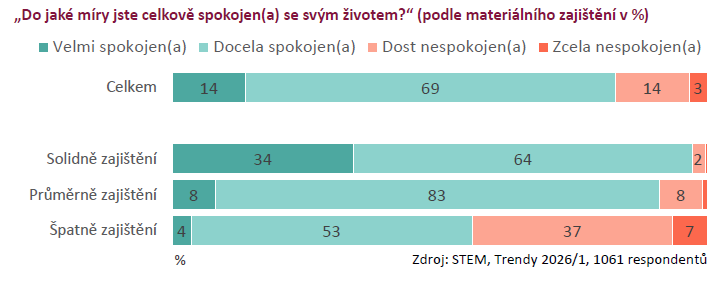
Most of the Czech public enters the new year with a joyful feeling of satisfaction with their own lives; only 14% are dissatisfied. An important factor in both personal satisfaction and the assessment of success of the past year is the financial state of the household. At the same time, it turns out that approximately one fifth of the population is satisfied with their lives, although they do not consider the past year to be a personal «dream». These people therefore maintain a sense of life satisfaction regardless of the evaluation of a particular year. The society-wide evaluation of the past year is traditionally depressing. Only every father or daughter believes that in 2025 there will be a development of society. On the other hand, this is the most positive result in the last six years. About a quarter of the public feel that the past year brought more justice, which also corresponds to relatively better values in this long-term critically perceived area. The assessment in both of these levels is significantly influenced by political attitudes – voters and the current opposition are particularly optimistic. Personal satisfaction remains high The overall satisfaction with life in the Czech population has been at a high level for a long time and has not experienced a significant turning point even in the last year. More than four-fifths of the population state that they are very or quite satisfied with their lives. This indicator shows high stability, and long-term data show that overall life satisfaction is relatively resistant to short-term crisis fluctuations. Therefore, even in times of economic and political shocks, most people manage to maintain a relatively positive assessment of their own life situation.
If the assessment refers to a specific year, in this case 2025, it sounds less favorable than in the case of a general assessment. Approximately two-thirds of Czechs and Czechs (67%) evaluate their personal situation in the past year – for example in the area of work, family and everyday functioning – as positive. However, when the overall life satisfaction is compared with the evaluation of the last year's success, it is shown that roughly a fifth of the population is satisfied with their life, although they did not consider the year 2025 to be a personal dream. This difference indicates that the assessment of a specific year is more sensitive to current events and short-term uncertainties, while overall life satisfaction is based on a more long-term perceived situation. The society-wide evaluation is quite pessimistic. A different picture emerges when evaluating the past year at the society-wide level. Approximately one third of the public (34%) believes that the year 2025 will bring success in the development of society, while two hundred people do not share this opinion. An interesting exception are young people aged 18-29, among whom the entire social development in the past year is positively assessed by every group (49%). The public's view of the development of justice is critical. Only roughly a quarter of Czechs and Czechs (26%) feel that society has become fairer in 2025. The exact difference between a relatively stable personal evaluation and a significantly depressing evaluation of the overall development of society belongs to the long-term findings of balanced STEM research and is also confirmed in this year's data. At the same time, despite the low share of positive evaluations, this is the most favorable result since 2021. The explanation of the discrepancy between positive personal evaluations and negative evaluations of overall societal development does not lead to the questionable influence of society-wide topics on the overall satisfaction of individuals. On the contrary, long-term STEM research shows that the public considers areas from public finance to housing affordability and climate change to security issues to be important, but also long-term unresolved. It is precisely the readability of these problems at the individual level, their long-term nature and often their direct impact on everyday life that can lead >to a separate assessment of the personal and societal level,' explains STEM analyst Doris Borovcov�.
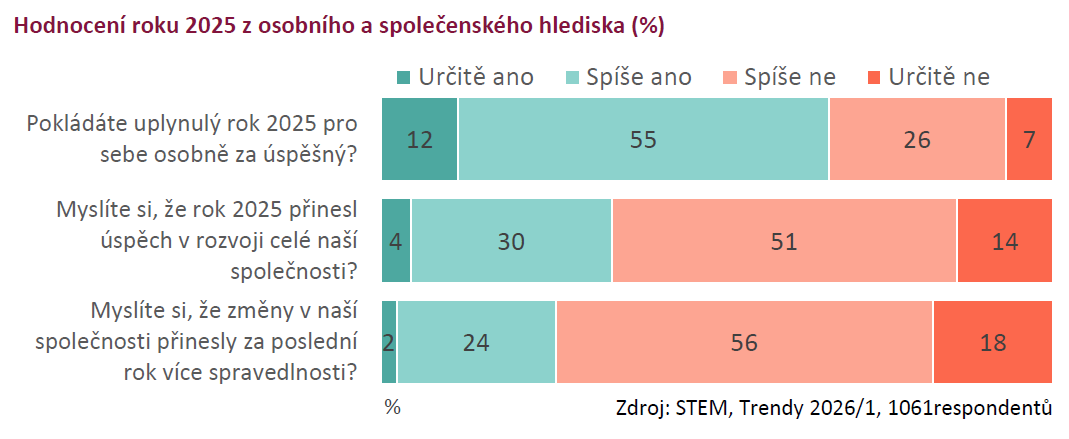 The long-term development of the balance sheet indicates a gradual revival of optimism. Looking at the development of the attitudes of the Czech public in recent decades, it is evident that economic and social crises, such as the financial crisis or the COVID-19 pandemic, are systematically reflected in the decline of all monitored indicators. While the impact of these crises on overall life satisfaction is moderate, it is most strongly reflected in the society-wide evaluation. As already mentioned, Czechs have a long-term tendency to evaluate the past year relatively positively from a personal point of view, while from the point of view of the development of society they are strongly critical. In previous years, the difference between these two levels reached very high values, but in the last two years, its slight approximation is noticeable. The evaluation of the strengthening of justice in society will remain critical in the long term, although even here in the last year there is a return to the relative value of the entire time series.
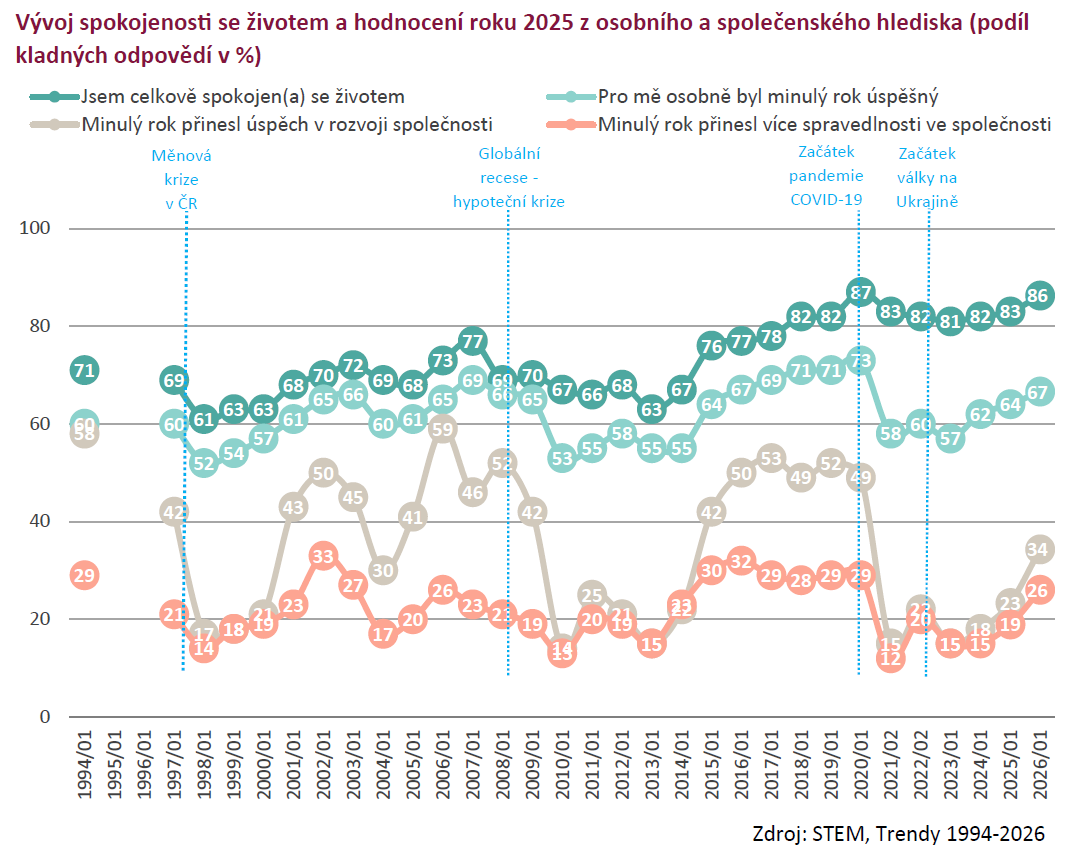
Emotions associated with the past year are often negative, although according to roughly a quarter of people, the past year went as it should. The emotions that people most often associate with the past year were fear, worry and uncertainty, which is reduced by roughly a quarter, among the most financially secure citizens with this feeling corresponds to more than 40%. From positive associations, the feeling that everything is going as it should, which we should understand as a pragmatic result of satisfaction, most often appears. This feeling, as well as fear and concern, was expressed by approximately a quarter of the people. An important role is also played by nava, which is mentioned by approximately one in ten people as a prevailing feeling. Long-term development shows that the combination of uncertainty and habit is a relatively normal state in Czech society, not an exception. Positive emotions, such as joy and a sense of urgency, remain present, but overall they form a smaller part of the emotional balance.
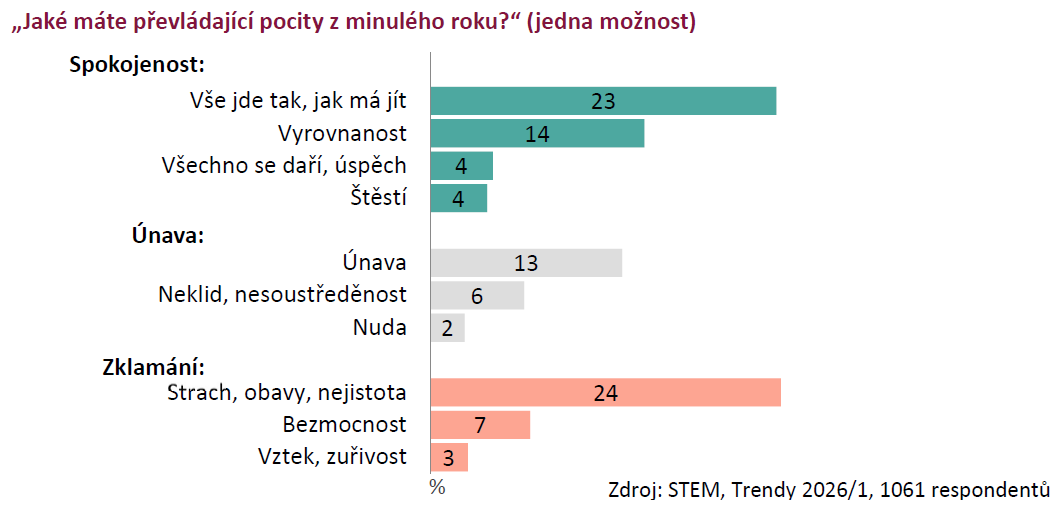
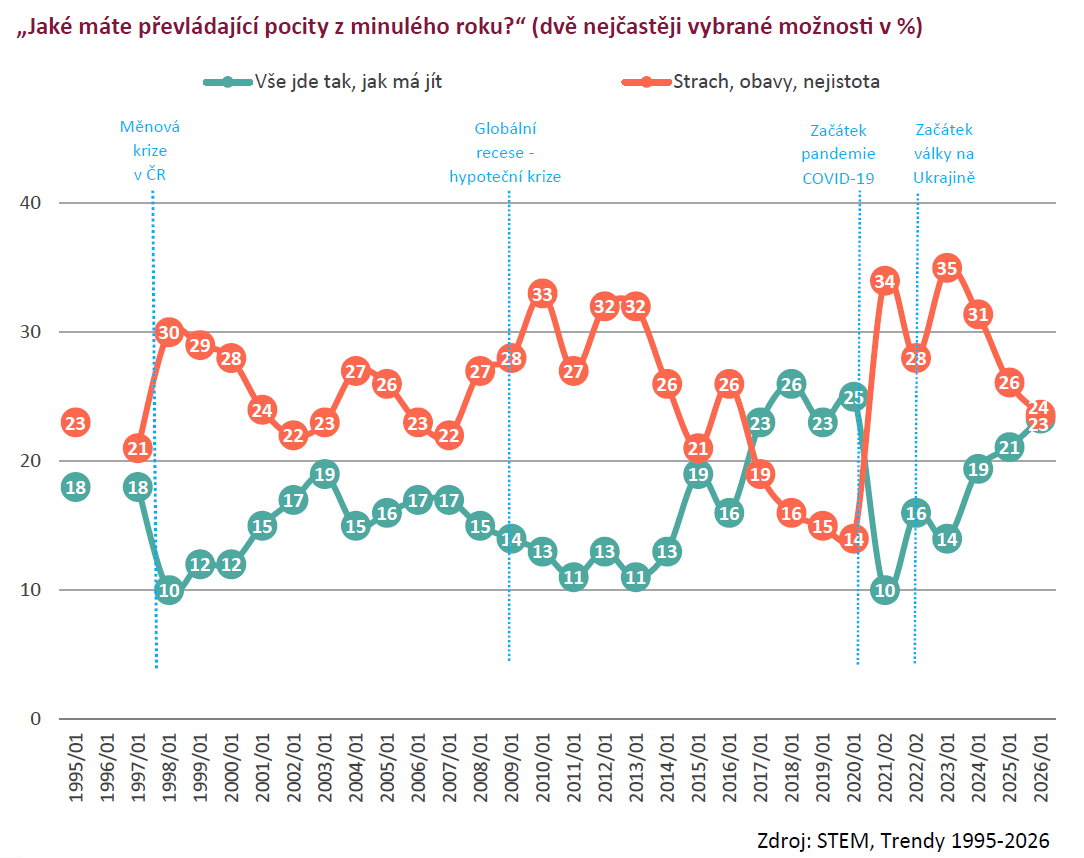
Taking a long-term view, it is evident that the proportion of people who associate the past year with fear, concern and uncertainty will decrease from 35% in 2023 to the current 24%. On the contrary, the feeling that things are going in the right direction has reached its highest representation since the pandemic, when less than a quarter of the Czech population associated it with the past year.
Personal and societal evaluations are influenced by the financial situation of the household and politics One of the strongest factors influencing the evaluation of life and the past year from a personal point of view is the material situation of the household. Among people who consider themselves to have solid or average material security, high life satisfaction prevails without exception, while among those with average security, satisfaction is often expressed more weakly, i.e. as «quite'' satisfied�. On the contrary, among those who rate their material situation as poor, there is a significant difference in terms of dissatisfaction, but even in this group, more than half of the respondents are satisfied with their lives. Material security is equally strongly reflected in the assessment of personal success of the past year or its emotional impact. People in a bad economic situation often feel insecurity, fear and disappointment, and significantly more often evaluate the past year as unsuccessful, also from a personal point of view. On the contrary, respondents with better material security more often associate the past year with a sense of balance and personal rush.
Such a political orientation will be strongly reflected in the evaluation of the past year 2025, especially in terms of social development. The voters of the parties of the new government will continue to evaluate the development of society in 2025 more critically, compared to 2024, however, a shift towards a negative assessment is noticeable in the majority of these groups. The most significant change appears among SPD voters, who, if they evaluate the year 2024 as extremely negative, while in 2025 the share of positive responses among them increased noticeably, they would continue to be in the minority. This shift is related to the outcome of the autumn 2025 elections, which sent some of these voters aware that their voice has weight in society. Given that the elections took place in the fall, this effect has only had a limited impact on the evaluations of the past year.
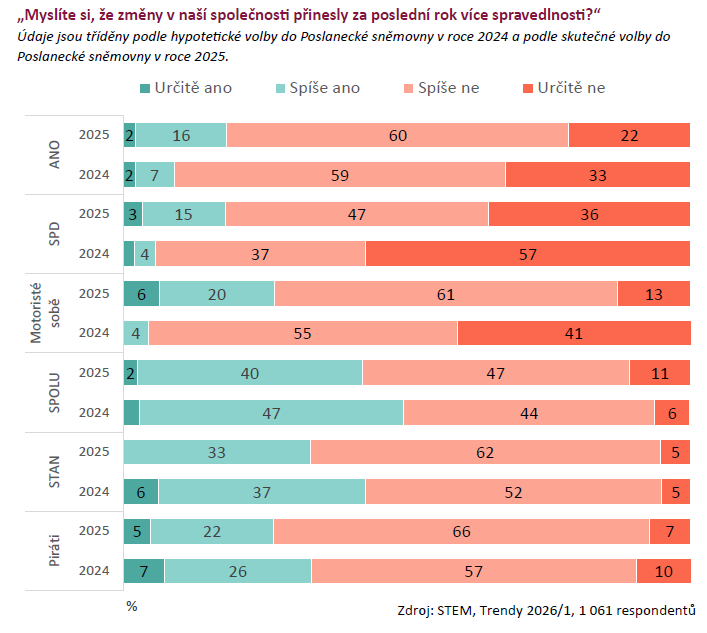
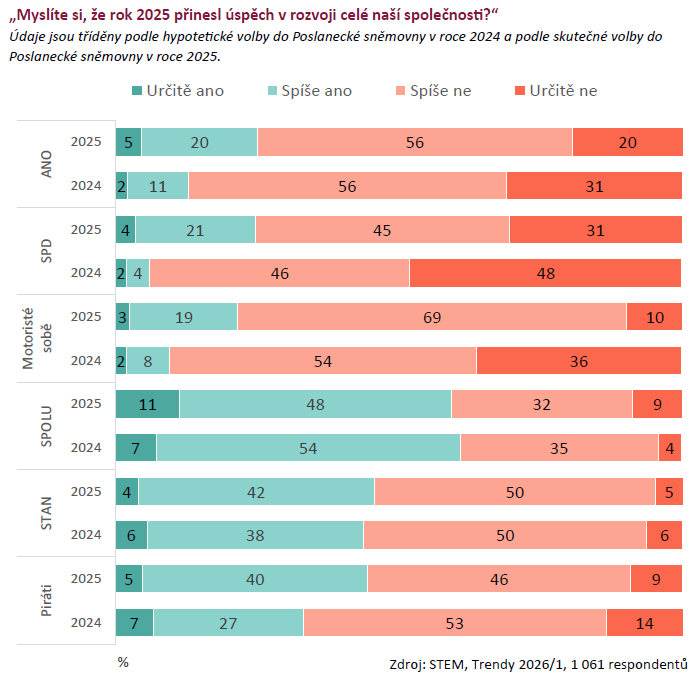 On the contrary, a positive assessment of social development prevails among voters TOGETHER in both monitored years. Less than half of the STAN voters rated social development very positively. The evaluation of 2024 was more depressing among the voters of Pir�t, but in 2025 their attitudes significantly approached the level of optimism of the voters of STAN and SPOLU. Overall, it is true that the voters of the opposition parties rate the development of society significantly more favorably than the voters of the parties of the new government, both in 2024 and in 2025. It will be interesting to see how the society-wide assessment of these people will develop in the next year. The perception of justice is one of the areas most sensitive to political attitudes and one where strong skepticism persists for a long time. Despite the slight improvement in the last year, there is still a prevailing opinion in society that justice has not yet been served. For example, political camps are dominated by negative responses, but their intensity is more pronounced. Relatively, the development of SPOLU and STAN voters is most positive, where approximately four out of ten respondents for the year 2025 state that the restoration of justice will be achieved, despite a slight decrease compared to the assessment of 2024. Among Pirît voters, a depressing and critical attitude prevails. evaluated both in 2024 and in 2025. The largest change in evaluations occurred among the Motorist self voters, who in 2024 were among the most critical, but in 2025 the rate of positive evaluations approached the same as Pir�t�. Among the voters of ANO and especially the SPD, the conviction that justice has not been promoted in society continues to dominate, yet in 2025 a slight improvement is noticeable compared to the previous year.
 Overall, even in 2025, most people will be able to maintain relative satisfaction with their own lives, while only a small percentage of the public perceives that society as a whole is developing in the right direction or more justly than in the past. However, these positions are not uniform. «The New Year's balance thus does not show a picture of the surface of satisfaction or dissatisfaction, but rather the internal, divided mood of society, into which are projected not only current social or political events, but also economic conditions, life experiences or value orientation of people,'' concludes STEM analyst Doris Borovcov�. The cited research on the analytical status of STEM (www.stem.cz) was conducted on a representative sample of the population of the Czech Republic aged 18 on 16.-25. January 2026. Respondents were selected using the flower selection method. The voter's file was further led to flowers and past election behavior. 1061 respondents answered the questions in a combination of online and personal interviewing (CAWI+CAPI). Data from other research series Trends, which are implemented using the same methodology, on a sample of approximately 1,000 respondents, are also used.

STEM was founded in 1990 by Jan Hartl. The organization grew out of the strength of several talents who created the first multi-track survey for continuous monitoring of the attitudes of Slovak society. The first survey of the opinions of STEM residents was carried out already in the spring of 1990. STEM specializes in a diverse range of quantitative and qualitative sociological research, the preparation of data bases and secondary analytical sources, consultancy based on data and the creation of communication strategies. We are members of the SIMAR association and adhere to its standards. More information at: www.stem.cz