
The big maneuvers. The Ethereum Foundation recently communicated on the technical progress surrounding Glamsterdam, the network’s next major update. During a developer gathering in Svalbard, Norway, the teams validated several structural steps. Initially scheduled for June, the implementation of this update is now planned for the third quarter of 2026. This transition is accompanied by a notable change in the leadership of the Foundation’s Protocol team. Will Corcoran, Kev Wedderburn and a developer named Fredrik now take over management of the cluster, succeeding Barnabé Monnot, Tim Beiko and Alex Stokes. This renewal comes as the network seeks to increase its processing capabilities while stabilizing its consensus rules.
The key points of this article:The Ethereum Foundation announced the postponement of the Glamsterdam update to 2026, aimed at improving the fluidity of the network.
A major change in leadership has taken place within the Protocol team, marking a strategic transition for the future of the Ethereum network.
Ethereum switches to Glamsterdam time
The Glamsterdam deployment mainly aims to increase network fluidity by a reorganization of transaction management. The Foundation has set a gas limit target of 200 million, which represents a significant increase from the current cap of 60 million. To support this increase without compromising security, the developers have stabilized the ePBS (Enshrined Proposer-Builder Separation) system. This mechanism allows validators to delegate the construction of blocks to specialized entities in a native manner, thus reducing dependence on external relays. This direct integration into the protocol rules gives the network more leeway to process large data blocks without noticeable slowdown. Furthermore, the finalization of EIP-8037 introduces new pricing for data storage. This proposal adjusts the cost of state creation operations to avoid excessive growth of the network database due to increased gas limits. By attaching costs to the volume of data generated, the protocol therefore seeks to maintain sustainable management of its history. Currently, test networks (devnets) for Glamsterdam are operationalallowing different customer teams to verify the compatibility of BAL (Block-level Access Lists) optimizations and new pricing structures before deployment on the main network.
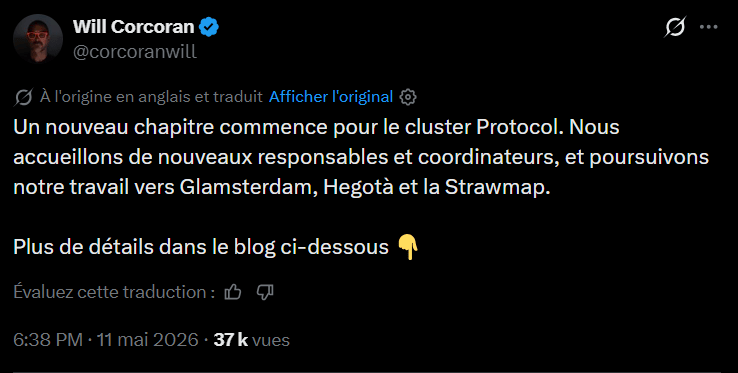 The new team communicates on the progress of the various projects around Ethereum – Source: Compte
Leadership transition and long-term strategic directions
The change of direction within the Protocol cluster also marks the beginning ofa new operational phase for the Ethereum Foundation. The new leads bring varied expertise: Will Corcoran focuses on research coordination and rapid confirmation rules, while Kev Wedderburn leads aspects related to zero-knowledge proofs (zkEVM). Fredrik, for his part, oversees the security of the protocol. This team succeeds the executives who piloted the Fusaka update in December 2025. The latter notably established PeerDAS and initiated the trajectory towards 200 million gas and the Foundation specifies that this transition is being carried out gradually in order to not to disrupt work in progress. Beyond Glamsterdam, the teams are already preparing thenext step named Hegotà. The first prototypes for the FOCIL system are functional and requirements for native account abstraction have been defined. This work is part of the Strawmap, a long-term roadmap aimed in particular at making the network resistant to quantum computing capabilities. The current strategy is to make protocol specific features more accessible to users while promoting a diversity of construction methods. Multi-client testing for Hegotà is now the immediate priority after Glamsterdam components are finalized. The technical stabilization and renewal of the coordination teams show a desire to structure the digital infrastructure sustainably. Pricing adjustments and native integration of build role separation should make the network more robust in the face of increased transactional load. The calendar for the coming months will be punctuated by monitoring the devnets and preparing the subsequent updates listed in the multi-year planning of the Foundation.