
The Fed signals the end of recess. There American Federal Reserve held its meeting on June 16 and 17, 2026 under the newly installed chairmanship of Kevin Warsh. Key rates maintained in the 3.50%-3.75% range, as anticipated. But it was above all the announcement by Kevin Warsh of the end of the guidance which caused a shock. The new president of the Fed indicated that the central bank would significantly reduce its communication on the future of its monetary policy, potentially including the “dot plot” (rate projection diagram). Result: the markets, accustomed to great transparency, have plunged into uncertainty.
The key points of this article:
The US Federal Reserve maintained its key rates, but its hawkish outlook on inflation caused a shock to the financial markets. The price of gold hit a six-month low, driven by massive outflows from ETFs and expectations of extended rates, while technology stocks fell sharply.
Gold already weakened, the Fed drives the point home
Gold hit its lowest level in six months last week, around $4,200 an ounce. The weekly fall had already reached more than 6%. The yellow metal broke its 200-day moving average, a negative technical signal. The main reason: markets now anticipate “higher for longer” rates, or even a possible increase by the end of the year (57 to 67% probability according to FedWatch tools). Inflation remains high, fueled by war in Iran and strong US employment data. Result: investors flee unprofitable assets like gold.
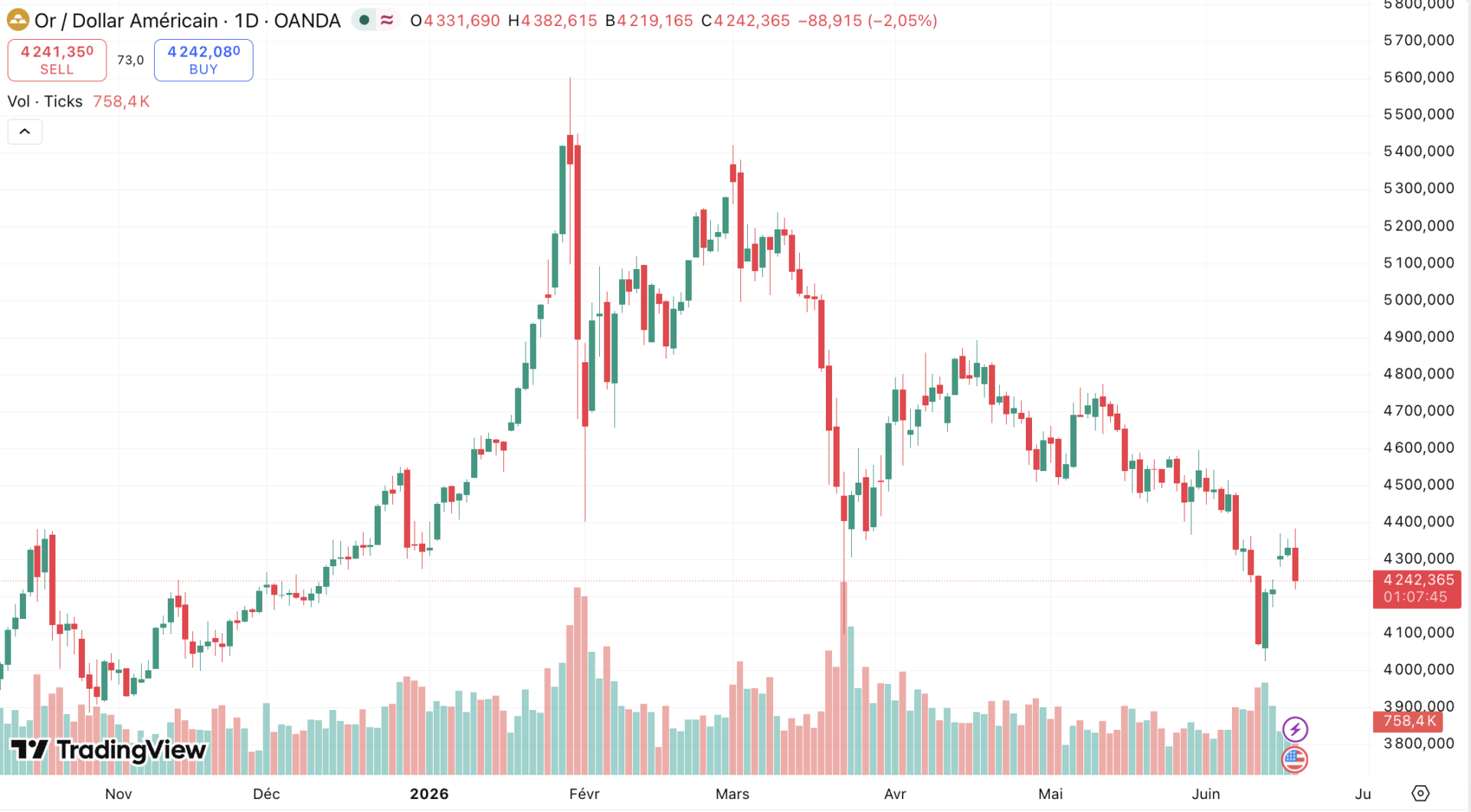 Source
Stocks are also bleeding after the Fed decision
The equity markets have violently reacted to the first meeting chaired by Kevin Warsh. The Dow Jones has lost more than 800 points since the decision was announced. The S&P 500 wiped out $1.2 trillion in market capitalization in less than two hours and was down more than 1% by the close of the press conference. Until SpaceX, although buoyed by post-IPO euphoria, ended up losing more than 5%, caught up by the hawkish shock of the Fed. The main reason for this fall is not only the your hawkish tone on inflationbut above all the announcement by Warsh of the gradual elimination of forward guidance. The new president suggested that the “dot plot” could be modified or even eliminated, as could certain forms of communication from the Fed. The markets, which until now operated with strong predictability, were punished by this new era of uncertainty.
Towards a regime change on the markets?
This movement marks the end of the “debasing trade” which had carried gold (and to some extent bitcoin) in recent months. In the short term, pressure remains strong on gold. UBS has also revised its forecasts downwards, citing a possible zone between 3,850 and 4,000 dollars. Longer term, many analysts remain positive on gold thanks to central bank buying and geopolitical tensions. But for now, the Fed has changed the situation: higher rates weigh on unprofitable assets. The upcoming inflation data and comments from Kevin Warsh will be particularly closely watched. Markets are now having to deal with a monetary environment that is less accommodating than expected.
Not Bitcoin ?
As we finish this article, Bitcoin is evolving around 65 000 $after testing the 64 500 $ in immediate reaction to hawkish signals from the Fed. The “debasing trade” which had driven alternative assets in recent months is clearly taking end with the prospect of higher rates for longer and a gradual reduction in forward guidance. Like gold, BTC is under the dual pressure of rising bond yields and liquidity that could become scarce. The correlation with risky assets has strengthened today. In the short term, $64,000 is a key support to watch. If this level gives way, an extension towards $62,000-63,000 cannot be ruled out in the coming days. In the longer term, structural flows (spot ETF, institutional adoption, government demand) and the persistent inflationary context could, however, limit the extent of the decline. The next interventions by Kevin Warsh and the inflation data will be just as decisive for Bitcoin as for gold.