
Fixed inflation (for now). In the United States, the figures forinflation PCE (Personal Consumption Expenditures) have just been updated. And it turns out that this personal consumption expenditure price index remained identical in February compared to that recorded the previous month. Will this stabilization of inflation be enough to push the Federal Reserve (the Fed) has lower these rates by the end of the year? Not so sure, because the next inflation figures will certainly be marked by the conflict in Iran.
The key points of this article:
U.S. PCE inflation remained stable at 2.8% in February, unchanged from the previous month.
The conflict in Iran could soon influence this index when it is updated in the future, potentially affecting the Federal Reserve's decisions on interest rates.
PCE inflation remained stabilized in the United States in February, still at 2.8%
The update of l’inflation PCE for the month of February 2026 has just been published this Thursday, April 9 by the Bureau of Economic Analysis (BEA). It shows an inflation of personal expenses which remains perfectly stable at 2.8% over a rolling year, exactly as in January (2.8%) and in line with economists' expectations (2.8%). On the side of PCE Corewhich excludes expenditure items with significant volatility such as food and energy, we even observe a slight decrease : the index passes from 3.1% to 3.0% over one year, in line with expectations (3.0%). But given that the conflict in Iran only started on February 28, the rise in the barrel of oil of last month (and therefore the excess energy expenditure) is not not reflected at all in the figures published today. You will have to wait a few weeks and the update for the month of mars pour measure the impact of the conflict over the PCE index.
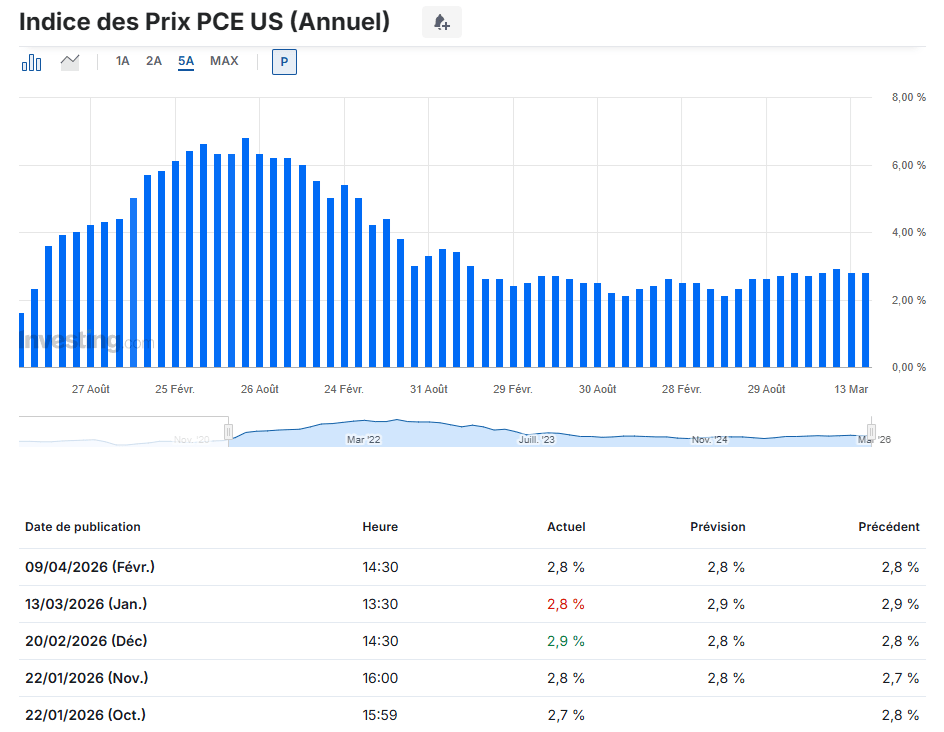 PCE inflation still remained stable at 2.8% in February in the United States. – Source: investing.com
Impact on the Fed and on Bitcoin: the rate cut still delayed?
The PCE indicator remains one of the favorite measures of the Federal Reserve to guide its monetary policy. With key rates fixed since December 2025 et Jerome Powell still in charge until Maythe central bank maintain a careful posture so far. And the risks of inflation linked to the conflict in the Middle East seem worry market players interviewed for the tool FedWatch of the CME Group. Indeed, according to the latter's survey, only 25% financial experts see a rate cut by December next. The crypto market still seems to have reacted positively to the stability of US inflation, since Bitcoin (BTC) managed to surpass the 72 000 dollars at the time of writing this article. All the main cryptocurrencies are also progressing by around +2% over an hour. PCE inflation therefore still remained very stable in February, continuing to barely oscillate around 2.8% for several months. But the conflict in Iran and the next inflation figures, which will most likely be on the rise, are troubling hopes for a resumption of lower interest rates from the Fed. Bitcoin and its ilk in any case do not seem to be worried, with a crypto market that is definitely showing itself to be very resilient for a month, despite the clashes in the Middle East.