
They are already among us. The blurring of boundaries between digital assets and usual monetary circuits becomes a reality with the normalization of stablecoins in everyday consumption. According to a report published on May 6 by Changelly, in collaboration with Simple, these tokens no longer only serve as a refuge for traders, but are now integrated into liquidity management and local settlements. With a global supply exceeding $300 billion in 2025 and a volume of on-chain transactions approaching $46 trillion, stablecoins are establishing themselves as a resolutely active financial tool. This dynamic reflects a search for stability and practicality on the part of users, who increasingly favor these supports for their daily operations. Details to follow.
The key points of this article:The blurring of boundaries between digital assets and traditional monetary circuits has come to fruition with the normalization of stablecoins in daily transactions.
Growing adoption of stablecoins has been observed, particularly through payment cards linked to cryptoassets, making transactions more voluminous and strategic.
Stablecoins: Growing adoption driven by payment cards
Analysis of Simple Wallet transactional data and surveys conducted with 3,000 users by Changelly reveals that 60.6% of respondents already use cards linked to cryptoassets. In Europe, the average basket of these transactions is around €40, an amount comparable to purchasing habits with traditional bank cards. Statistics show that 60% to 70% of spending concern ongoing costssuch as food shopping, digital subscriptions, transport or outings such as cafes or restaurants. This regular usage indicates that crypto cards now act as utility payment rails rather than just one-time liquidation tools. Automation of conversion, particularly to USDC at settlement time, allows holders to retain their assets until the purchase is validated. At the same time, user motivations are based on simplicity of usecited by 65% of respondents, as well as on rewards programs and cashback for 56% of them. The flexibility offered by these devices, which allows you to stay invested in the digital ecosystem until checkoutreinforces the appeal of these solutions. Platforms like Changelly also observe that transactions involving stablecoins are on average five times larger than those involving other assets, highlighting their role as a strategic liquidity layer. This trend suggests that the payment model is gradually migrating towards an approach where the management of financial flows frees itself from deadlines and constraints traditional banking infrastructures.
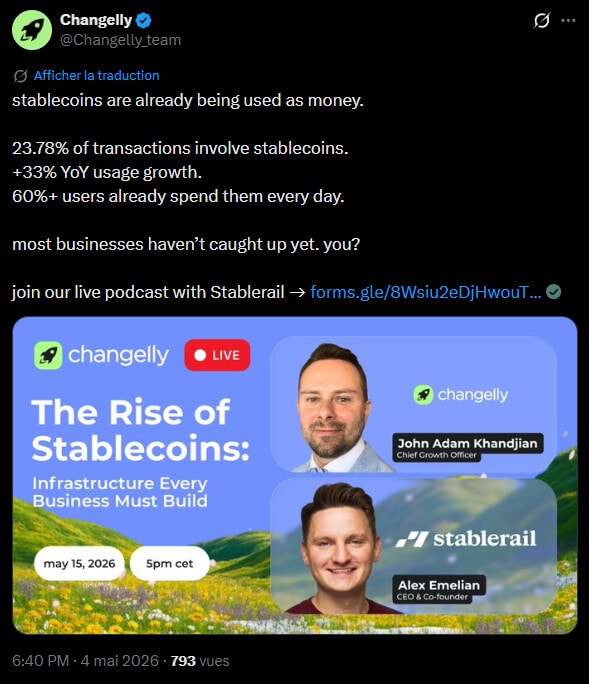 Almost a quarter of transactions now involve stablecoins according to the Changelly study – Source: Compte
Barriers to entry and the evolution of infrastructure
Despite this rapid progress, certain obstacles further limit widespread adoption. The study highlights that 58% of non-users mention a lack of knowledge as the main obstacle, ahead of the lack of possession of cryptoassets or service fees. It thus appears that education and understanding of products constitute more decisive growth levers than simple technical innovations. While 59% of current users report no major technical issues, the remaining challenges mainly concern limited acceptance by certain merchants and perceived complexity during initial setup. To meet these challenges, industry players are relying on familiar banking interfaces and simplified identity verification processes. The evolution of infrastructure towards increased interoperability between Web3 and the real economy therefore becomes a priority for companies. Digital wallet providers and exchanges are now optimizing their cash flows to minimize foreign exchange costs and improve settlement reliability. This standardization of stablecoins demonstrates users’ interest in solutions combining digital agility with the stability of fiat currencies. The ability of issuers, platforms and specialized media (such as Journal Du Coin) to fill the information gap will determine the extent of adoption in the years to come. But the anchoring of these tools in mass consumption definitely marks a transition towards more integrated payment systems and less dependent on traditional circuits. The world is changing very quickly and you are at the forefront so as not to miss anything.