
The speed of circulation of stablecoins has doubled in two years. Far from being mere speculative tokens, they are now replacing the global banking infrastructure. Deciphering an underlying trend that is redefining return generation. The stablecoin market is maturing. According to Standard Chartered Bank, the overall “velocity” of these assets – the frequency with which they change hands – has doubled over the past two years. Today, one digital dollar is traded on average six times a month. This article contains affiliate links allowing you to support the daily work of the Journal Du Coin teams.

A $2,000 billion market despite everything
In economics, faster circulation means less money is needed to support the same volume of trade. The overall demand for new tokens could therefore have fallen. Yet, Geoff Kendrickhead of crypto research at Standard Chartered, maintains his forecast. He anticipates a market 2 trillion dollars by the end of 2028.
“If velocity remains constant, increased transactions will create demand for more stablecoins, but if it increases, this will not”
The analyst specifies that this acceleration reflects a shift towards new use cases. “Additive” uses which do not cannibalize existing savings.
The strategic divide: USDC vs USDT
On-chain analysis reveals a clear division of roles between the two market giants.
USDC for TradFi and AI: Circle’s token carries most of this acceleration. Since mid-2024, it has actively replaced traditional banking rails (TradFi). This dynamic is boosted by autonomous payments linked to artificial intelligence, in particular via the protocol x402 on Solana and Base.
USDT for safe haven savings: Conversely, Tether's velocity remains low and stable. It dominates the savings segment in emerging countrieswhere it serves as a local monetary shield. The analysis firm Garlic confirms this anchoring in the real economy. Today, 84% of payment volume in stablecoins is carried out at the domestic or intra-regional level.

The explosion of this market poses a simple question. How can the individual investor benefit from it? The answer no longer lies in frenzied trading. If stablecoins become the financial infrastructure of tomorrow, the most rational strategy is to act like the bank: provide liquidity. In the traditional banking system, intermediaries absorb the majority of the value. In decentralized finance (DeFi), these bureaucratic “frictions” disappear.
Larry FinkCEO of BlackRock, the largest investment fund in the world, highlighted this in his letter addressed to investors:
“Decentralized finance is an extraordinary innovation. It makes markets faster, cheaper and more transparent. (…) The reason? The removal of frictions: legal, operational, bureaucratic, allowing more people to access higher returns. »
By lending your stablecoins on these networks, you directly capture the fees generated by this record velocity. It is this mechanism that allows you to aim for double-digit annual returns, by exposing yourself only to the dollar.
Discover DeFi and put your savings to work
Decentralized Finance can be scary because of its complexity. And it is to respond to this growing problem that we created the 25% Club.
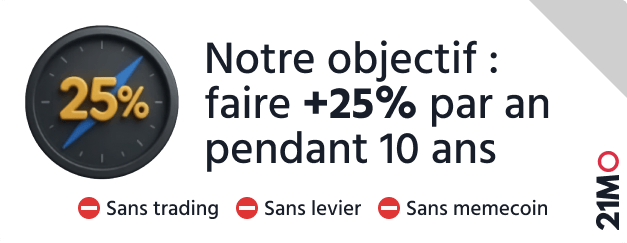
This group today brings together 150 investors (executives, managers, retirees) with a simple objective: to generate 15 to 25% annual return on stablecoins, by devoting a few hours per quarter. Here is how the club works in practice:
A public portfolio of $100,000: Managed in real time by Lucas (co-founder of Journal du Coin), all investment decisions are explained and documented.
“Click by click” guides: The best DeFi opportunities are audited and popularized. Simply follow 5-minute video tutorials to invest your funds.
Total autonomy: You remain the sole control of your money via your own crypto wallet (self-custody).