
10 years of the second halving of Bitcoin. In this seventh article of Crazy Crypto Storieswe change register. No hacks, no crashes, no sulphurous characters. This week, the protagonist is the code itself, and a rule written into the Bitcoin protocol from the beginning, which is automatically triggered every 210,000 blocks, whether we like it or not. Last week, we talked about the hack of The DAO and the split of Ethereum. Today, we return to Bitcoin to tell the story of one of its quietest and most important moments.
Le halving de Bitcoin
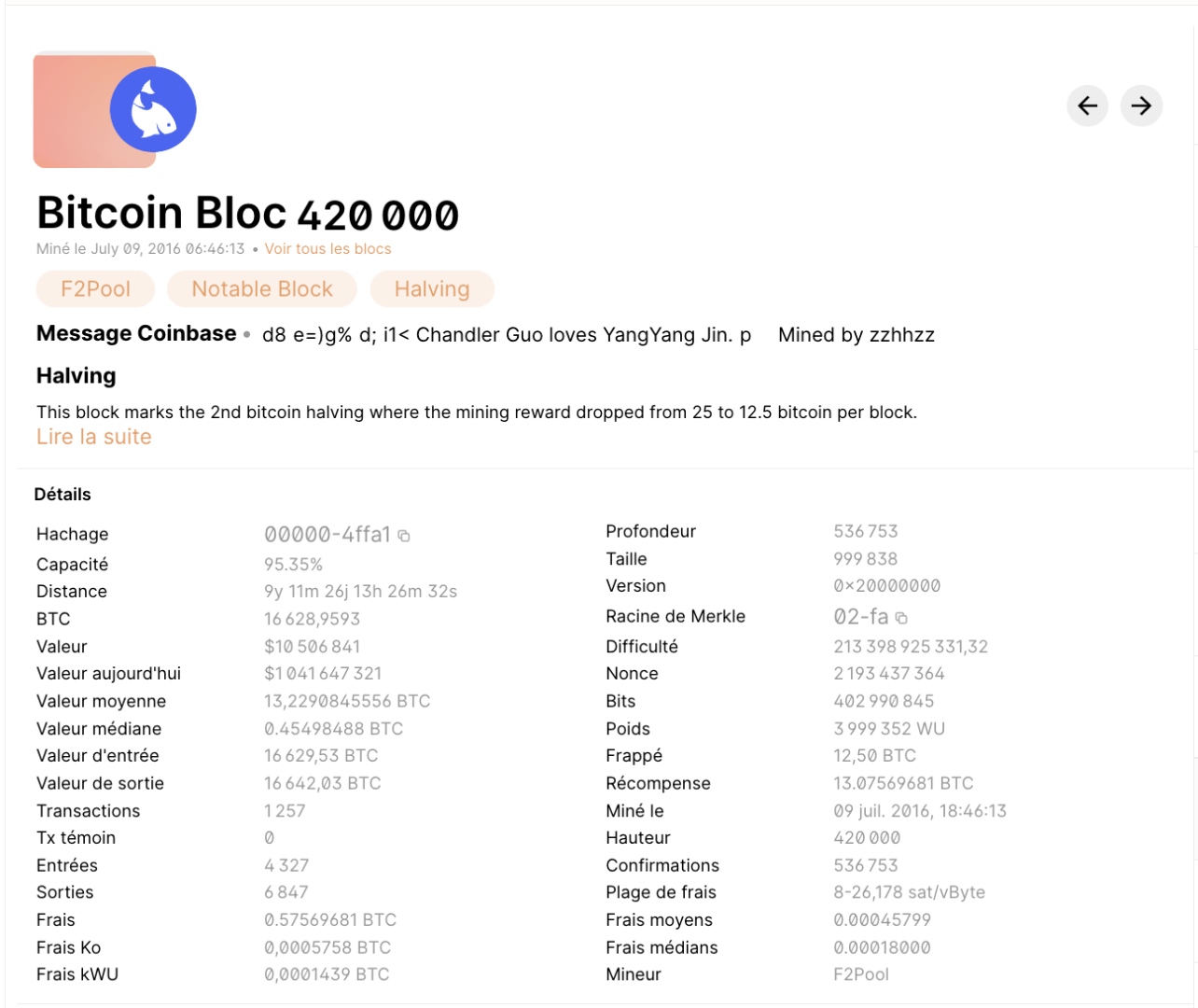
When Satoshi Nakamoto a conçu Bitcoinit has integrated a mechanism: all 210 000 blocs mined, approximately every four years, the reward given to miners for each new block is halved. At launch in 2009, this reward was 50 BTC per block. First halving in November 2012: 25 BTC. Second halving le July 9, 2016 : 12,5 BTC. And so on, until the reward reaches zero, around 2140, and the 21 million bitcoins are all in circulation. The idea behind this mechanism is simple: create a scheduled scarcitypredictable, unmanipulatable. No one can decide overnight to print more bitcoins. No central bank, no government, not even Satoshi himself could have deviated from this. Bitcoin halving is written into the protocol as a law of physics: it applies to block 420,000, period.
2016, or the 420,000 block
In 2016, the Bitcoin community is following the countdown with new excitement. THE first halving of 2012 went almost unnoticedBitcoin was still confidential. But in July 2016, the context is different. Bitcoin has survived the Mt. Gox hackto the collapse of 2014, to the thousands of articles announcing his death. It is around 650 dollarsor 52 times the level it was at during the first halving of 2012, as CoinDesk recalled on July 7, 2016, two days before the event. Entire sites are dedicated to counting the remaining blocks. THE bloc 420 000 is mined on July 9, 2016 by the pool F2Pool. In a fraction of a second, the reward goes from 25 to 12.5 BTC. On Bitcointalk, messages are multiplying, some euphoric, others disappointed that the price did not immediately explode. This is the essence of halving: its effects are never seen on the big day.
The economy of planned scarcity
What halving actually produces is a reduction in the new supply of bitcoins on the market. Before July 2016, miners collectively received approximately 3,600 new BTC per day. After : 1 800. If demand remains stable or increases, the price must mathematically rise, it is the law of supply and demand applied to an asset whose emission is predictable to the nearest second. Historical data seems to validate this thesis: each halving was followed, within twelve to eighteen months, by a major bull run. After that of 2016, Bitcoin went from 650 dollars to almost 20 000 dollars end of 2017. Correlation or causation? The debate remains open, but it fuels each cycle the same anticipatory fever in the community.
Bitcoin halving: the lesson
What makes halving fascinating from a narrative point of view is its total lack of drama. No vote, no press conference, no human decision. A block is mined, the code runs, the reward changes. The network continues. The miners continue. And somewhere in the protocol, the clock restarts for another 210,000 blocks. In a financial world accustomed to opaque decisions by central banks, this automatic and transparent mechanism has something almost revolutionary in its banality. Satoshi didn’t need to convince anyone: he just wrote the rule, and let the code enforce it, forever. To go further, our Coin encyclopedia looks at the complete economics of the block reward.