
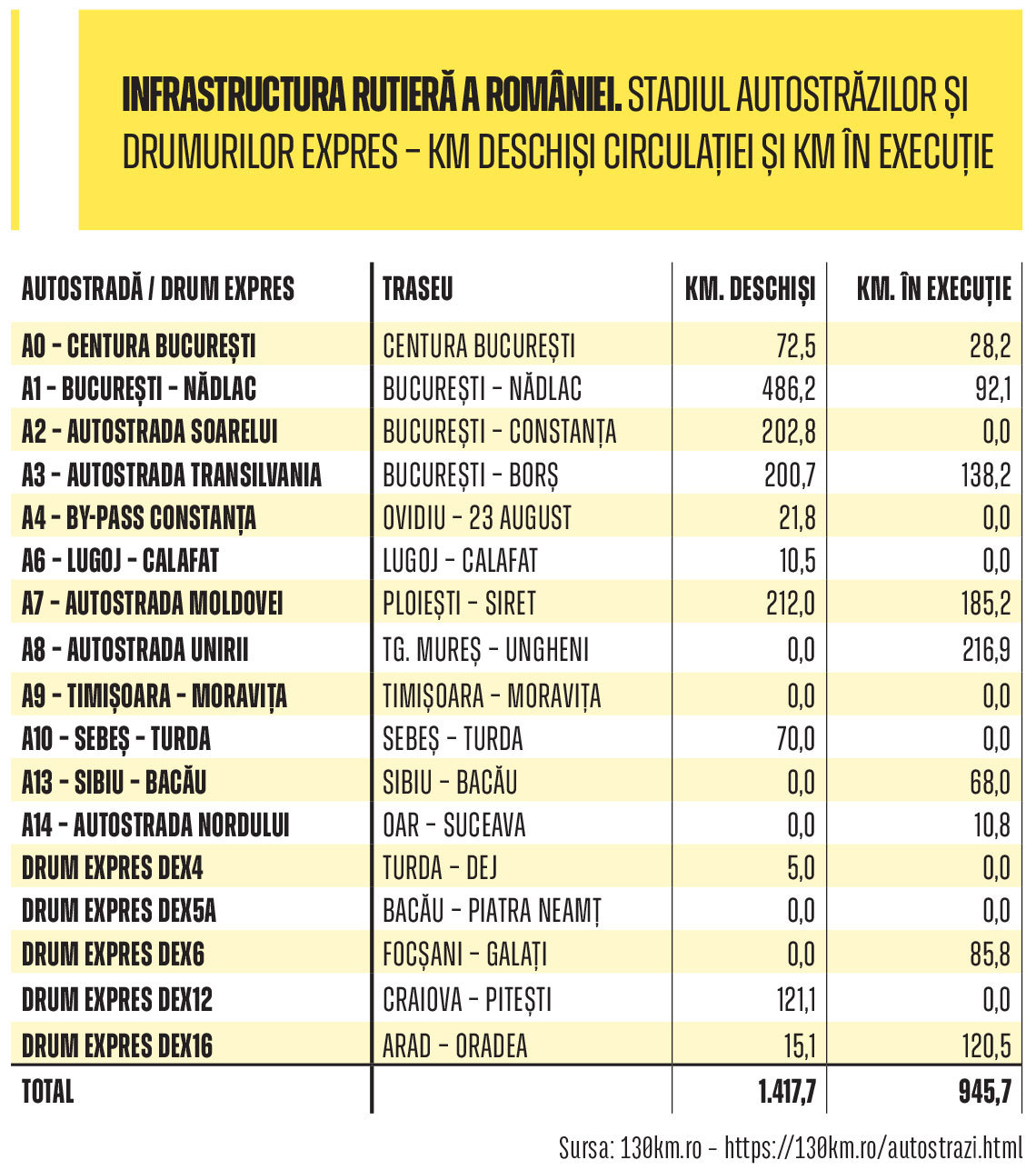
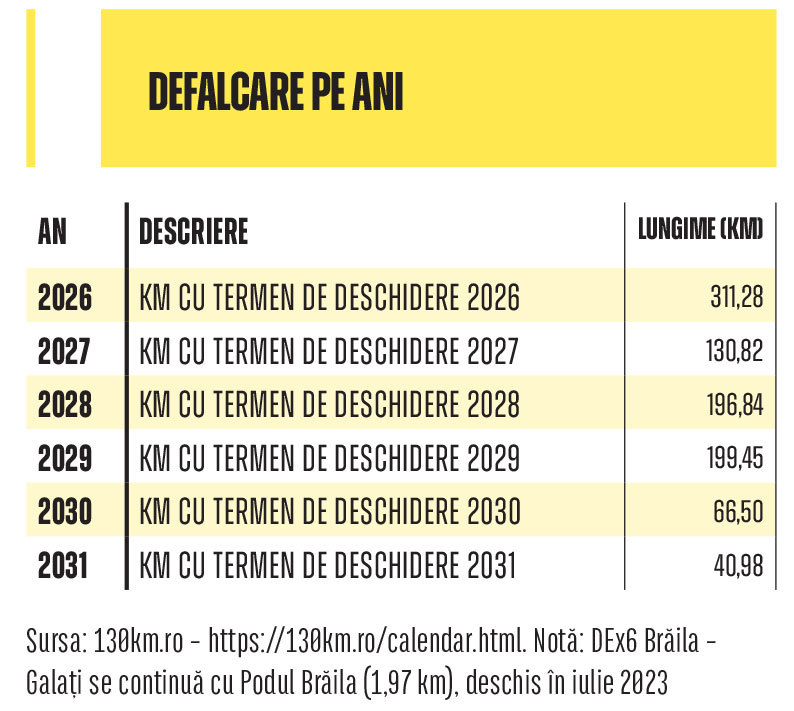
In the coming years, the logistics map of Romania will be rewritten on several concrete pillars: the completion of the A7 up to the Turbion junction in the Paşcani area, the entry into execution of the A8 between Târgu-Mureş and Târgu-Neamţ, the opening of the Focşani-Brăila construction site which will enhance the Brăila bridge, the launch of the Brăila-Tulcea tender and the start of the design for Bucharest-Giurgiu, with a radial section towards Alexandria which could be the first public-private partnership in the country’s road infrastructure. CNIR has 400 kilometers in its portfolio, and the Ministry of Transport announces 830 kilometers of highway and expressway under construction, with a target of 230-250 km put into traffic this year – the best year in the history of Romania in this regard.
Romania is entering a phase in which, for the first time since joining the EU, highway construction sites are no longer grouped only along the traditional Nădlac-Sibiu-Bucureşti-Constanța corridor. The center of gravity of the network moves to the east and northeast, via the Moldovei Highway (A7) and the Unirii Highway (A8), and a new logistics corridor appears in the south that will connect Bucharest to Giurgiu and, via radials, to Alexandria. In addition to these, Focşani – Brăila, Brăila – Tulcea and Filiaşi – Târgu-Jiu are included in the calculation, plus section 2 Biharia, which will close the connection with the Hungarian border. Gabriel Budescu, the general director of the National Road Investment Company (CNIR), explained at the ZF Logistics, Transport and Automotive 2026 conference that the institution he leads has in its portfolio four sectors of a mountain area on the A8, between Târgu-Mureş and Târgu-Neamţ, all that means the section Târgu-Neamţ – Iaşi – Ungheni financed by SAFE, Focşani – Brăila, Ploiesti – Braşov, Bucharest – Giurgiu in design, to take over Filiaşi – Târgu-Jiu, plus the Biharia construction site – section 2, which will connect with the sector already in traffic at the border with Hungary. «We are talking about 400 kilometers in total», stated Gabriel Budescu. At the ministry level, the mechanism runs in parallel. Ionel Scrioşteanu, secretary of state in the Ministry of Transport and Infrastructure, announced at the ZF Trends in the office and construction market conference that Romania has 830 kilometers of highway and expressway under construction, and by the end of the year between 230 and 250 kilometers could be put into traffic. «We remain optimistic about the best year in the history of Romania in terms of highways and express roads. In 2024 we put 200 kilometers into traffic, and this year we will certainly exceed 200 km», Ionel Scrioșteanu said.
A7, open to traffic in stages until Pašcani
On the Moldova Highway, the calendar is staggered. «We will open traffic up to Bacău in the first stage, and then in August, the next beyond Roman, up to Mirceşti, and then by the end of the year we will also close the last lot, the one with the Turbion node in the Paşcaniului area», explained Ionel Scrioşteanu. For CNIR, A7 is also the managerial matrix of the other projects. «We started the seventh, we had it in coordination with the team that is now at the CNIR level. We started the design in 2019. We are talking about seven years from the moment the design started. This means a long-term strategy», Gabriel Budescu pointed out.
A8, signatures until May 31 and a plan B
On the Autostrada Unirii, CNIR has assigned all four lots from the financing through the SAFE mechanism, but the appeals to some of them prevent the signing of the contracts. «We are doing everything we can, we are trying to sign them by May 31. There is also a plan B in case we do not succeed, but I hope that this month we will clarify everything that means appeals and assign them,» said Gabriel Budescu. The construction cost has increased considerably: 35–40 million euros per kilometer in the mountainous area, compared to around 15 million euros in the plains. «We want to have quality works and here I will insist, because the prices for highways have also increased considerably. The quality will have to be consistent», added the CNIR director. The investments pushed up the price of land around Iasi. «There are localities where we have eight times more expensive. We also have to do the expropriations. This year we updated the report and they have increased a lot, probably in light of the investments that are preparing to come with the highway», explained Gabriel Budescu. At the eastern end of the network, this year the works are to be started both on Joseni-Ditrău, where a Romanian contractor won, and on Focșani-Brăila – «to be the first major investment that enhances the Brăila bridge», pointed out Gabriel Budescu. Also this year, the tender for Brăila-Tulcea, a road considered strategic for Dobrogea, will be launched.
A0 Nord and the provisional downloads
On the Capital’s Beltway, Ionel Scrioşteanu detailed the completion schedule for the northern area. The section between DN1 and DN1A is to be put into traffic in June-July 2026, followed by the section from DN1A to the junction with lot 2, in the vicinity of the A1 Bucharest-Pitesti highway. Lots 3 and 4 will be put into traffic «somewhere in August-September, cumulatively, because the junction is in the DN3 area, where unloading is not planned». The Ministry is considering a temporary unloading on DN3 if the difference between the two construction sites increases.
Bucharest-Giurgiu and the radial towards Alexandria, possibly the first PPP
The newest chapter in the portfolio is the Bucharest-Giurgiu corridor, and Teleorman, Giurgiu and Ilfov counties also enter the scene here. «In Bucharest – Giurgiu, we are at a stabilized database and here we have advanced the project quite well. We have six route options to analyze», explained Gabriel Budescu. The specification expands the analysis: «We started in the specification to analyze from Giurgiu to 1, up to Bucharest – Pitesti and the route. If the ministry decides to finance only from Giurgiu to Ghimpati, in the end somewhere 20-25 kilometers could be the subject of a PPP», stated the CNIR director.
The strategy of the ministry, in the version discussed, would be that the section from Ghimpați to Bucharest – on the direction DN6 Bucharest – Alexandria – be taken out for public-private partnership. «And then the traffic participants, freight carriers or not, have a choice. You come to Ghimpați, you go on Bucharest – Alexandria to the A0, you enter there, or you pay a toll and go on. In the end, cost versus time,» explained Gabriel Budescu. CNIR is already working on an analysis regarding the possibility of financing in PPP, as a distinct chapter of the feasibility study. «We will be forced to take the PPP into account,» Gabriel Budescu said. This is also the message sent last week in Iasi by government officials, including Mihai Jurca, the head of the prime minister’s office, who pleaded for the acceleration of these partnerships. The model, says Gabriel Budescu, must start with small projects. «We need to start with a smaller project, make one to serve us as a pilot project in the future and then go to bigger projects, which we will develop in PPP. Within this group that I am active in and which is funded by the United States Chamber of Commerce, there are colleagues from several countries and just a month ago I talked with a colleague from Poland. They concluded a PPP for 400 or so housing units, a contract that they stayed on for four years to negotiate it and sign it», explained the CNIR director.
Ploiesti-Braşov, unblocked after six rejected geotechnical projects
On Ploieşti-Braşov, after many disagreements with the provider, the contract entered the straight line. «After many discussions and six rejected geotechnical topics, we reached an agreement and they convinced us that they will be in the field to start the geotechnical study campaign,» Gabriel Budescu said. Also in the mountain area, the A7 between Paşcani and Suceava enters a new stage this week: «It’s about the Paşcani-Suceava section. There are two contracts with an announced winner, which could be signed, but we needed this emergency order to have the financial arrangement finalized», explained Ionel Scrioşteanu.
First motorway toll, over 5–10 years
Budgetary, the Romanian state will be forced to diversify its sources. «Probably somewhere in 5-10 years we will start having taxes» on the highways, estimated Gabriel Budescu, explaining that the financing model can become circular: you tax a completed sector to finance the next one. «It was discussed at one point about charging Bucharest – Ploiesti to finance Ploiesti – Brasov, but we must be aware that, when Pitesti – Sibiu is ready, all freight traffic to Nădlac will go to Sibiu», explained the CNIR director.
Local materials, parapets and Romanian concrete
In addition to the new corridors, the infrastructure of the next decade will also change the industrial footprint. On Bucharest – Giurgiu, CNIR wants to do a public analysis of concrete versus asphalt. «Currently, I believe that more than 90% of the bitumen used in the country is imported, from Austria and Poland. We propose to make an analysis regarding what is more profitable – to build with concrete or with asphalt road layers», stated Gabriel Budescu. For parapets, the option leans towards the concrete New Jersey parapet, because «we don’t really produce a metal parapet in Romania». The calculation is simple for the local market: cement factories exist, and the transport of materials over long distances affects the existing network.
Service spaces, disconnected from the construction site
Another structural change concerns gas stations and service areas, where A3 Câmpia Turzii–Suplacu de Barcău remains a warning. On Focşani-Brăila, «we provided in the specification that the contractor complete the service spaces at least 6 months before the completion of the traffic sector, precisely with the idea of giving time to make these concession contracts», explained Gabriel Budescu. CNIR also wants to change the aesthetics of these spaces, in order to abandon the standard image of large areas of concrete.
Administrative capacity and Romanian entrepreneurs
The CNIR team outsourced the supervision to specialized companies. «Part of the team from CNAIR is the team that thought up the design of the A7 highway. It was easier for us to carry out these projects up to this stage,» Gabriel Budescu said. On the side of entrepreneurs, the local market has matured: «We now have six companies with over 1 billion euros in turnover in this field. They gained expertise before, in the previous wave of highway construction.» In order for them not to go through the 2010–2014 scenario, when many large road transport companies disappeared, the infrastructure needs predictability. «In addition to the highest possible rate of construction, let’s have a strategy to stick to, that is, something predictable», the CNIR director said. On the existing construction sites, the diesel price pressure is real. «We certainly have this pressure on all the construction sites we have open. We are constantly discussing at the government level to find solutions. We have formulas for adjusting the price of the contracts and apply all the measures», said Ionel Scrioşteanu. The lesson of the pandemic – adjustment mechanisms to price pressure – keeps the construction sites open for now. For Romanian logistics, the new map means more than extra kilometers. It means alternative corridors to the Danube ports via Focșani – Brăila and Brăila – Tulcea, the closure of the A0 ring around Bucharest, the opening of the western border via Biharia 2 and, for the first time, a public-private partnership pilot project in the direction of Bucharest – Alexandria – Giurgiu, in a county – Teleorman – which for two decades was on the edge of the highway map.