
Remember the last crash… It’s the statistics that make the headlines this Monday. The stablecoin market has lost around $10 billion in capitalization since May 2026, including $7.7 billion in June alone. A figure which, at first glance, rings alarm bells: this is the strongest monthly decline since the collapse of TerraUSD in May 2022, one of the worst episodes in recent crypto history. Except that the context, this time, has nothing to do with it. It remains to be understood why.
The key points of this article:
The stablecoin market has lost approximately $10 billion since May 2026, with a notable decline of $7.7 billion in June, reminiscent of the TerraUSD crash of 2022. Some of this capital has redirected into US stocks and other forms of onchain yield, without signaling a widespread flight out of the crypto ecosystem.
USDT and USDC lead exits, but no fire in sight for stablecoins
Tether (USDT) has fallen from around $190 billion to almost $184 billion, while Circle’s USD Coin (USDC) has fallen from almost $80 billion in March to around $73 billion today. Two giants which, between them, concentrate most of the decline. But the comparison with 2022 quickly ends. This decline only represents a 3% contraction of the total stablecoin market. Which was not the case at the time. Indeed, in 2022, the combined capitalization had fallen by 166 billion to 122 billion in the space of eighteen monthsa collapse of 26%, triggered by the death of Terra then the cascade of bankruptcies FTX, Celsius, BlockFi and Genesis. Nothing to do, therefore, with the current situation. We stay on one correction, not on a hemorrhage. The graph below shows this visually: the current fall is almost invisible on this scale compared to the low of 2022
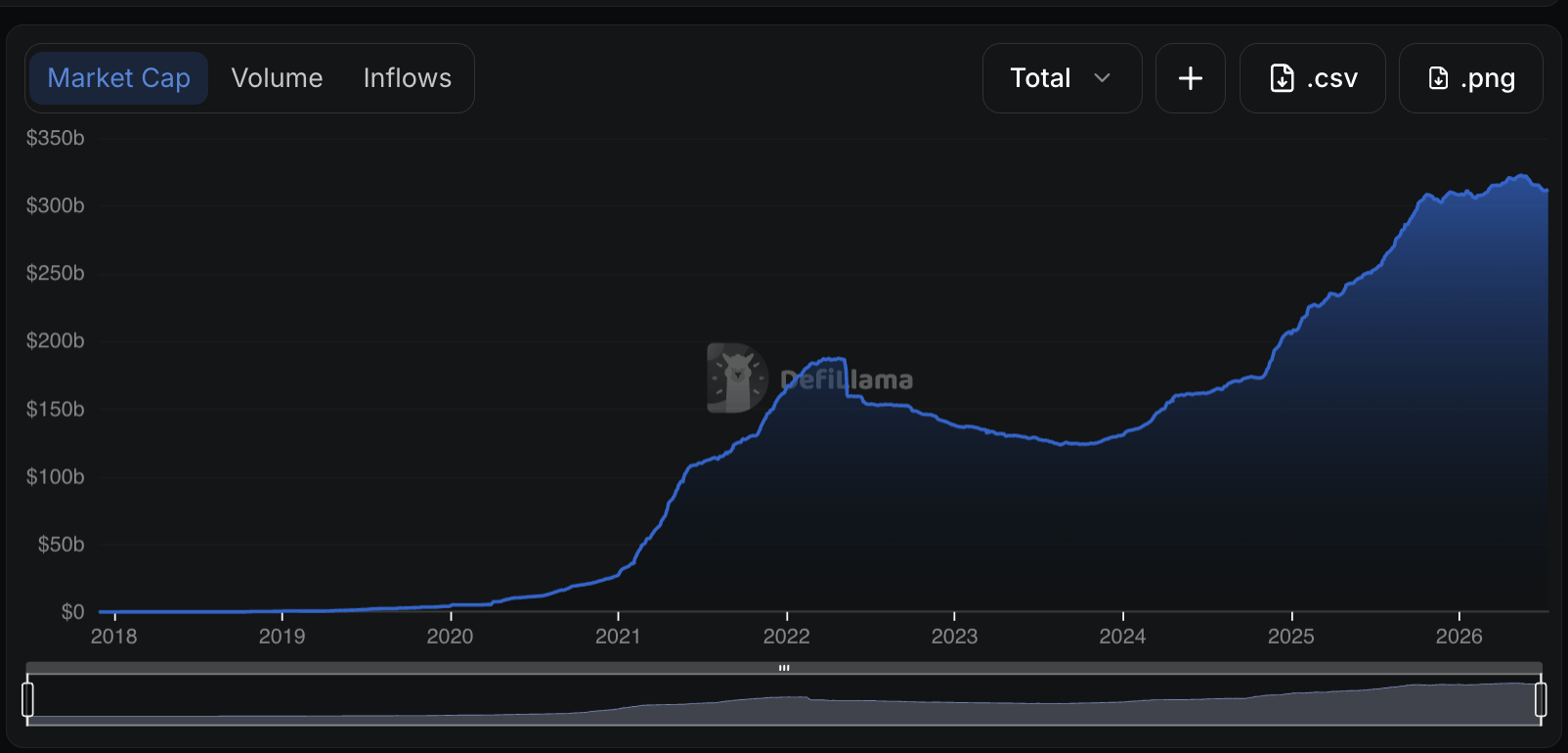 Source : DeFiLlama
Where does the money really go?
Part of the capital leaving stablecoins is not fleeing crypto: it is redirected towards American equities, driven by a renewed appetite for risk in traditional markets with theIPO of AI giants like SpaceX. Logical, in a sense: when equity indices climb and the returns there seem more attractive than a tokenized dollar which yields nothing in itself, investors arbitrage. Some analysts also mention an effect of rotation to other forms of onchain yieldlending protocols in particular, where stablecoins do not really disappear but simply change their statistical appearance. Not enough, in any case, to see this as a signal of widespread flight from the crypto ecosystem.
A credibility test despite everything
However, it would be naive to completely brush the subject aside. Stablecoins play a central plumbing role throughout the crypto ecosystem : they serve as collateral on trading platforms, as a temporary refuge between two positions, as a payment rail for international exchanges. Prolonged erosion, even modest, deserves to be closely monitored rather than ignored out of reflex reassurance. Especially since the regulatory context is evolving quickly on both sides of the Atlantic, between the debate around the Clarity Act in the United States and the MiCA framework in Europe, which are redrawing the rules of the game for issuers. The real question is perhaps not whether this 10 billion will come back, but whether the stablecoin market will emerge from this period of regulatory turbulence with the same architecture as today, or completely reshuffled.