
♦ «The year 2025, for the crops of last autumn, was with record productions for wheat and rapeseed, but for sunflowers and corn we are in a depressed phase» ♦ Romania obtained this year 12.6 million tons of wheat, a record level, and a production of 6 million tons of corn is estimated, the lowest level in the last ten years, according to COCERAL. Agriculture, a field that is generally sensitive to weather conditions, has become weather dependent in the last five years. In this context, adaptability is a necessity for Romanian farmers, who have already changed the way they approach the activity in the field. The Romanian farmer evolved from a decision taken instinctively to one planned through a medium and long-term strategy and from the orientation towards volume and profit to the search for a balance, was one of the conclusions of the ZF Agribusiness Summit 2025 «Agriculture: from food to business. What is the future of the Romanian farmer?». «In the last ten years, I have witnessed a behavioral change among farmers, which gives me optimism and shows me that things are going in the right direction. The Romanian farmer has evolved from instinct to strategy, from reaction to planned activity, from orientation towards volume and profitability to orientation towards balance. We are witnessing a generation of farmers who are more open to new things and we are witnessing more prudence», said Monalisa Ungureanu, CEO of Agri Romania, distributor of seeds, fertilizers and plant protection products. She also said that, analyzing the evolution of the last ten years, in the last three years agriculture has been marked by a series of challenges: climate changes (drought, heat) and geopolitical factors. Thus, after several difficult years for spring crops, the reduction of the areas cultivated with corn from almost 2.5 million hectares to 1.9 million hectares now is a strategic decision and shows that the Romanian farmer is looking for long-term security and stability. «The year 2025, for the crops of last autumn, was with record productions, both for wheat and rapeseed, but for sunflowers and corn we are in a depressed phase», she emphasized. Romania obtained this year 12.6 million tons of wheat, a record level, and a production of 6 million tons of corn is estimated, the lowest level in the last ten years, according to COCERAL. The estimated cereal production for 2025 is 22.5 million tons (Ă9% compared to 2024), and the estimated oilseed production for 2025 is 4.6 million tons (Ă35% compared to 2024). The positive contribution is brought by rapeseed. «In recent years, rapeseed has become the queen of agricultural crops, because it brings money to the farm and brings it quickly. It is a great advantage for farmers. If we look back 20 years ago, rapeseed was cultivated only on a few thousand hectares. Today, we are already approaching a million hectares, which shows the orientation of farmers towards more profitable crops and not necessarily autumn crops. Agriculture today should no longer be measured in hectares, but in productivity and profitability, and farmers know this very well. They have been true entrepreneurs in recent years, and the decrease in corn acreage shows us that they think profitably», said Tomel Petrache, product management manager at KWS Seminţe.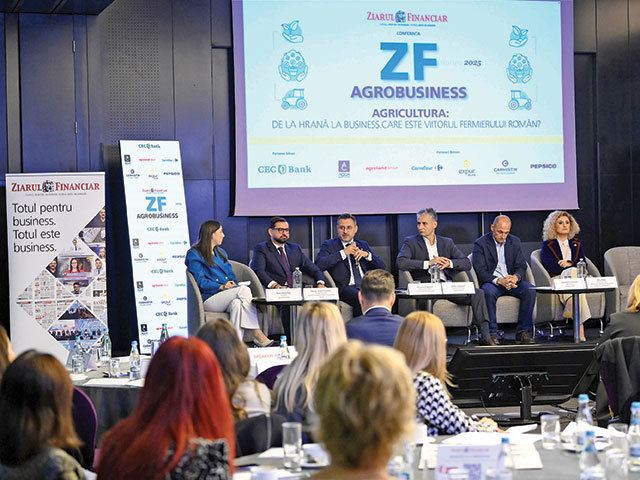 Also, Bogdan Alexandrescu, director of the Agricultural Department within CEC Bank, emphasized that the last few years have been difficult for agriculture and that a change can be observed in the approach of farmers who work on large crops. «Statistically speaking, it rains more from autumn to spring than from spring to autumn, which means that more farmers have established more autumn crops and I think this year they have exceeded 60% of the total area. We are seeing a record year for canola and wheat, which makes farmers more bankable», the banker confirmed. For his part, Ianco Zifceak, co-founder of the Maxagro company, said that he obtained record productions for wheat and rape, but the results for corn and sunflowers were not good. He believes that in order for Romania to maintain its leading position in the European Union in these crops, corn and sunflowers, it is necessary to develop irrigation systems, so that agriculture does not depend exclusively on the rains that may or may not come.
For other news, analyses, articles and business information in real time, follow NV on WhatsApp Channels