
Is this the end? The oil markets showed a marked decline this Monday, May 25 under the effect of prospects for geopolitical appeasement in the Middle East. A barrel of Brent from the North Sea fell by around 5% to settle at around $98.30, while the American benchmark, West Texas Intermediate (WTI), fell towards the threshold of $92. This easing of prices is a direct result of the progress of diplomatic discussions between the United States and Iran, which suggests a possible increase in global supply. Investors now factor in the possibility of an orderly resolution, which limits speculative upside strategies.
The key points of this article:Oil markets suffered a marked decline due to prospects of geopolitical appeasement in the Middle East, with a notable drop in the barrel of Brent and West Texas Intermediate.
Diplomatic discussions between the United States and Iran point to a potential increase in global supply, thus influencing investors’ speculative strategies.
The parameters of diplomatic negotiations and the issue of Hormuz
The bearish dynamic is fueled by official declarations describing the current exchanges as constructive. The American administration mentions significant progress in the development of a framework agreement, even if the authorities specify that no text has yet been finalized. The American president notably indicated that he did not intend to rush the conclusion of the discussionsbelieving that the position of his country remained favorable. The sanctions and maritime blockade in force will apply until certification and the signing of a final compromise. The major technical issue of these discussions is based on the reopening of the Strait of Hormuza strategic maritime route through which nearly 20% of world oil production usually circulates. A memorandum of understanding could also formalize freedom of navigation in this area, in return for a partial unfreezing of Iranian assets and a gradual lifting of restrictions economic. Nevertheless, notable points of divergence remain, in particular on the aspect of the nuclear program and on the nature of the inspections required by Washington. Internal validation by the executive power in Tehran could also require a delay of several days.
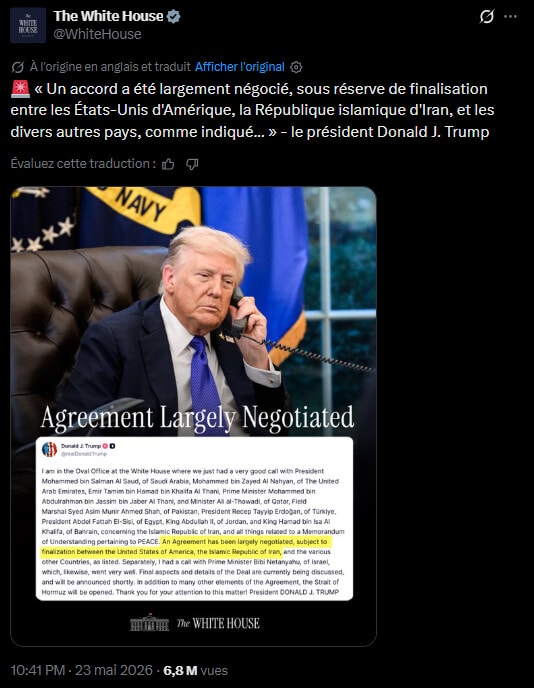 The White House seems optimistic about an end to the crisis in the conflict in Iran – Source: Compte
Oil: Structural implications and market expectations
This revaluation of prices modifies the supply prospects of oil-importing countries in the medium term. The markets anticipate that a stabilization of the geographical area would allow a regular return of exported volumeswhich would ease tensions on Western refining capacities. For the European economies, and in particular for the French market, this decline in crude oil offers a possibility of stabilization of fuel prices at the pumpalthough the effect is not immediate due to storage times. The dependence of prices on geopolitical factors, however, confirms the uncertain nature of forecasts energy for the rest of the year. Analysts point out that the absence of a precise timetable for the final signing maintains latent volatility. The behavior of other oil-producing countries, particularly within OPEC+, will constitute another determining factor for overall balance if the Iranian offer were to be fully reintegrated into official circuits. The fluctuations observed at the start of the week illustrate the sensitivity of energy markets to signals of international relaxation. Brent’s decline below $100 shows that fears of a prolonged supply disruption are fading in favor of a more pragmatic approach to trade flows. If a framework agreement is emerging to guarantee the security of maritime routes, resolving fundamental questions on the nuclear issue will probably require long verification phases. The sustainability of this decline in prices will therefore depend on the transformation of these declarations of intent in verifiable contractual commitments.