
The era of maturity. The adoption of digital assets in France and Europe follows a stabilizing trajectory after several years of notable growth. According to recent data collected by Adan (Association for the Development of Digital Assets), 93% of the French population is now aware of the existence of these assets, a level of awareness comparable to that of Germany or the Netherlands. This massive dissemination of information indicates a certain maturity of the market, where theoretical knowledge of crypto gives way to progressive integration into wealth strategies. Although the effective holding rate is stabilizing around 11% in France, the profile of investors is becoming more refined and revealing increasingly measured management behaviors.
The key points of this article:Crypto adoption in France has reached a level of maturity, with 93% of French people aware of these assets.
French investors are predominantly young, male, and their strategy is characterized by prudent management and progressive integration of digital assets into their assets.
Adan 2026 barometer: Profile of holders and investment strategies
The typical profile of the French holder according to the 2026 Adan barometer remains predominantly male (70%) and relatively young, with an average age of 39 years. These investors, often with higher education qualifications, now consider these assets as a complementary component of their heritage rather than as a simple vector of speculation. Portfolio management is characterized by real prudence : 80% of holders have less than 5,000 euros in digital assets, and the majority carry out less than one transaction per month. This passive approach suggests a long-term holding strategy, where Bitcoin (66%) and Ethereum (39%) remain the pillars of diversification. Moreover, storage habits are changing. If 66% of users still favor the simplicity of third-party exchange platforms, self-holding via personal wallets now concerns 23% of investors. This trend is accompanied by an increased curiosity for more technical assets. Stablecoins, although known by only 16% of the general public, occupy a growing place in active portfolios (20%). They are mainly used for liquidity and payment managementwhile interest in euro-denominated versions is growing rapidly among regular users.
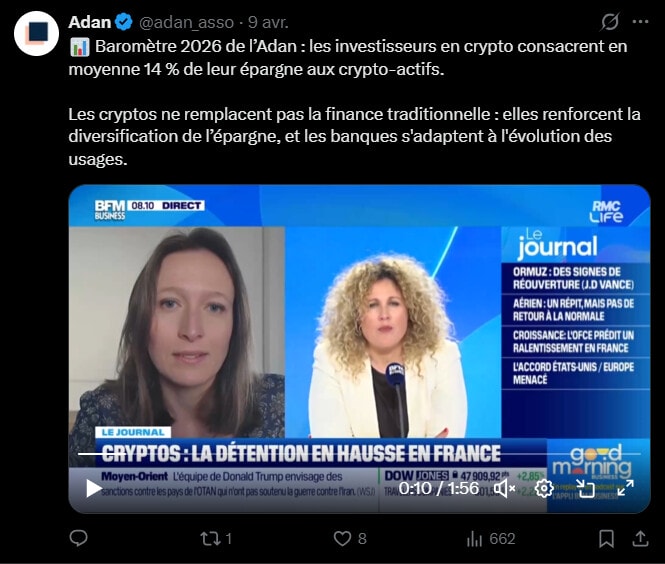 Claire Balva, Director General of Adan comments on the 2026 barometer in the media – Source: Compte
Institutional integration and regulatory challenges of French crypto
The French financial ecosystem benefits from the involvement of institutions such as Caisse des Dépôts, which supports the structuring of the market through the tokenization of bonds and the development of sovereign infrastructure. This institutionalization promotes trusteven if traditional banks are perceived as still timid in their digital service offerings. At the same time, the adoption of decentralized finance (DeFi) is growing, with 50% of cryptoasset buyers using automated protocols for lending or borrowing. These new uses transform financial infrastructures by providing more transparency and liquidity. However, the regulatory and tax framework remains a point of friction for many users. Around 39% of French people judge national regulations too restrictivea feeling that reaches 77% among active investors. The complexity of taxation is cited by 78% of respondents as a major obstacle to adoption. Despite these criticisms, the entry into force of the European MiCA regulation is seen as a factor credibility and security on a continental scale.
This European standardization could therefore reduce the ownership gap observed between France (11%) and countries such as the Netherlands (20%) or Germany (17%). The maturity of the French market is reflected in pragmatic adoption, where crypto fits into a broader picture including stocks and gold. The diversification of uses, in particular via the tokenization of classic financial instruments and the development of stablecoins, confirms that the sector goes beyond the stage of simple technological curiosity. For the years to come, the simplification of tax processes and smoother integration by traditional banking players will constitute the main levers for broader adoption. The confidence of savers now relies on the clarity of the rules and securing conservation infrastructure.