
♦ «Productivity means doing more with the same number of people» ♦ «We see AI as a tool that increases productivity. It's a new tool, similar to the information revolution of the 2000s» ♦ «Technology helps us get rid of certain repetitive tasks to take over other operations, to be more productive» ♦ «If you want to open a factory, if you don't consider robots you can't be competitive» ♦ «What I want is to triple the activity with the same number of employees.» ♦ «An important component is how you teach people to use the technology.» Increasing productivity today is no longer the direct result of expanding teams, but of companies' ability to intelligently integrate technology into their processes. Artificial intelligence comes with a paradigm shift: organizations want to generate more value with the same human resources. In this new model, competitive advantage lies in how humans and algorithms work together to accelerate results.
Georgian Andrei Oprişor, general manager (people product), Revolut People «Artificial intelligence is having a significant impact in HR. We see it as a productivity-enhancing tool. It's a new tool, similar to the information revolution of the 2000s. It had a major impact then and we're still seeing the effects today. Companies are still adapting. It won't be as big a shock as people think. AI will replace some things, but essentially it will create more jobs than it will eliminate, that's my opinion,» said Georgian Andrei Oprisor, general manager (people product), Revolut People, at the ZF HR Trends 2026 conference. In his opinion, the effects of AI will not generate an abrupt shock on the labor market, but a gradual transformation, similar to the appearance of the computer, which led to the creation of completely new professions. «If we look at the advent of the computer, there was no programmer job in the 70s-80s. Today it is commonplace. It will be the same with AI, it will create new roles. HR will not be replaced, but it will be transformed into performance agents. Just as the Internet has changed our lives, so will artificial intelligence. New jobs will appear, different from what we do today. (…) The AI revolution and robotization will change the way in that we work in. 10 years ago we didn't imagine that we would work from home so much, and now it's a reality», added the Revolut representative. Alexandru Ungureanu, HCM sales director, TotalSoft, says that technology comes in many cases with an increase in productivity and that it should not be viewed with fear by employees.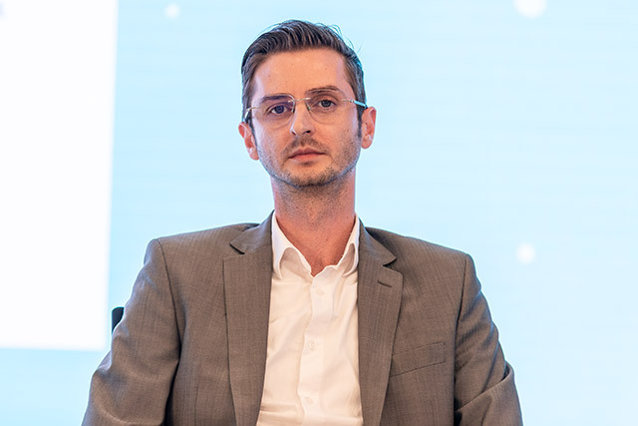 Alexandru Ungureanu, HCM sales director, TotalSoft «We should not be afraid to adopt a new technology. We have done this in the past, for example when we started using software applications. AI now also comes with some suggestions, proposals, but the decision is still up to us. The challenge is the fine line between human intervention and the use of an AI-based agent,» he said at the ZF conference. From the perspective of companies that manage large volumes of data and processes, the immediate gain is the elimination of repetitive tasks. «We take care of the salaries of 15% of the workforce in Romania. I see an openness from partners in adopting new technologies, to be more competitive. Technology helps us to be more productive, but we have to allocate the time obtained to the employee. HR is changing its role. Technology helps us get rid of certain repetitive tasks to take over other operations, to be more productive. If you want to open a factory, if you don't take robots into account, you can't be competitive. It's the same in an organization when using applications, new technologies», explained Alexandru Ungureanu. Although investments in technology are increasing, results are not guaranteed without an essential component: employee training, says Rodica Rapcea, people & culture director, METRO Romania.
 Rodica Rapcea, people & culture director, METRO Romania. «Systems, technology and digitization have been talked about, and indeed they are very helpful if you want to increase productivity. But another important component is how you teach people to use technology. Otherwise, they can get stuck in it and you actually end up reducing productivity. If I'm talking strictly about METRO, we're number one globally, within the group, in terms of productivity – measured in volume and turnover per employee. Productivity means doing more with the same number of people. We constantly look at indicators such as productivity and costs, for each store and function. Interventions are adapted: where needed, we invest in training or retention», she explained in HR Trends 2026. Ovidiu Teodorescu, CEO of UCMS, emphasizes that organizations are increasingly looking for solutions that eliminate time lost on compliance and allow HR specialists to focus on real impact: retention, engagement and development.

Ovidiu Teodorescu, CEO of UCMS by AROBS «I know several thousand jobs are being created this year in Romania among our clients. What is important for them is how they will be able to secure those jobs, how they will be able to keep the good ones, this can only be done with healthy human resources policies. We come after a great investment effort and bring to the market applications that can manage today's problems of human resources people and they can deal with what makes them relevant on the market. We are being asked for more and more functions and modules to we simplify the lives of HR people, nobody wants to waste their time with compliance issues, they want to do impactful things for their employees and the companies they operate in,» he detailed. The paradigm shift in terms of productivity is already visible in the way companies define their goals. If in the past growth usually meant more employees, today the target becomes «more with the same people». «We, Creasoft, by autumn consider that we are reaching maturity with our Creasoft HR platform and we want to develop a new product, which will be a relatively automatic support application. When I gathered my support people and said to them: Starting today, any question that comes from a customer, you put it in a table on the left side, and everything you answered, you put on the right side. I told them that in the fall I release a large part of programmers and we're starting a support automation software that's going to be based on the application instructions and all the previous correspondence with the customers. A bolder one said to me: No, the goal is to outsource our solution and we want to triple the activity with the same number of employees, but if I didn't have this thing in mind so many people, this means AI and it's not only in the support area», said Adrian Dinu, founder of Creasoft.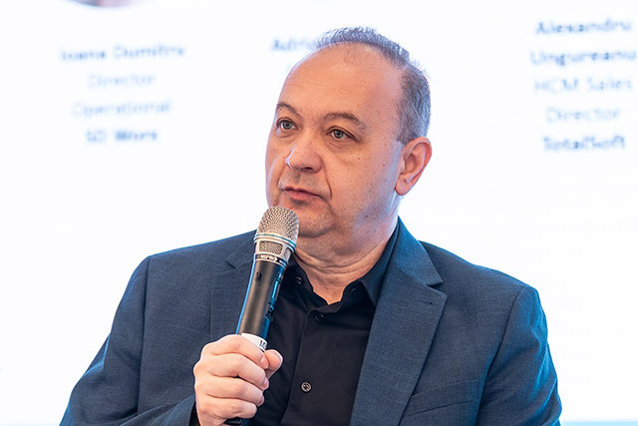 Adrian Dinu, founder of Creasoft. Making the way we work more efficient becomes critical in an economic context where companies are under pressure to deliver services faster and cheaper. «I also look at what the market demands from us every day, how it evolves, what the dynamics are, what the legislative changes are, all of these are things that we have to keep up with and we look very carefully at how it was done 10 years ago, but we have to look and think very seriously and how these processes will transform in the next 10 years. We expect that we will be asked to be good, fast and maybe much cheaper than we are today, everything to be much faster, much more automated and as correct as possible».
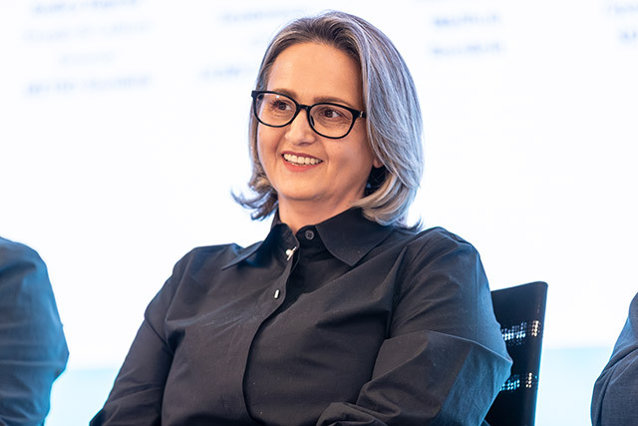 Ioana Dumitru, operational director, SD Worx «If we looked back, we were talking about the area of compliance, to be on point from a legislative point of view, maybe that was the basic requirement. If we look to the future, we talk a lot about speed and flexibility», said Ioana Dumitru, operational director, SD Worx, during the ZF HR Trends 206 conference. A problem that companies must be aware of in this period is the lack of a clear technology implementation strategy, says Andrei Ianculescu, Head of Project & Development Services Cushman & Wakefield Echinox.
 Andrei Ianculescu, Head of Project & Development Services Cushman & Wakefield Echinox. «We frequently see, in the initial discussions, the requirement: «we want to implement technology», without any clarity on what is specifically desired. Also, we do not look at the types of generations that exist in that office, nor at the communication and training component, which can directly influence productivity following the implementation of technology,» he detailed. Another increasingly important factor in the productivity equation is the well-being of employees, as Dan Moraru, country lead, Wellhub Romania, says.
 Dan Moraru, country lead, Wellhub Romania. «We also have a great opportunity in the area of productivity for employers. It is an opportunity to correlate the investment in the well-being of employees with the results of the company. It is a reserve of productivity that we can employ, located outside the job. At work we increase productivity through motivation, through AI, through processes. But after work they return to private life. And the next day I come with the impact of 16 years spent in private life. If I have recovered enough, I will come connected, able to I offer quality work. There are two important processes: recovery through sleep and recovery through what I do for my well-being, sports, therapy, etc.,» he explained.
For other news, analyses, articles and business information in real time, follow NV on WhatsApp Channels