
Chainalysis has released a global report on crypto adoption, addressing regional trends and revealing what's next in the global crypto industry. The blockchain data platform's work is called «The 2025 Geography of Crypto Report» and includes valuable data from Sub-Saharan Africa, North America, Latin America, Asia-Pacific and Europe.
Crypto adoption in Europe
Chainalysis reveals that cryptocurrency adoption in Europe reflects a combination of convergence and transformation, based on data analyzed between July 2023 and June 2025. During this period, the European region demonstrated remarkable growth and resilience, with transaction volumes following a specific pattern: In mid-late 2024, the market experienced a decline. At the end of 2024, the market saw a strong rebound, peaking in December at $234 billion. The momentum continued into early 2025, demonstrating that the European market has matured due to institutional and retail adoption across member states. Referring to the extended European region, Chainalysis shows that between July 2024 and June 2025, Russia was the leading crypto market with a total value received of more than $376 billion, followed by the United Kingdom with more than $273 billion. Germany and Ukraine recorded more than USD 200 billion in received value.
top countries in the extended European region by total value received between July 2024 and June 2025 – Chainalysis data Other countries, including Ukraine, France and Spain, recorded more than USD 100 billion in total value received, while Italy, Romania, Poland, the Czech Republic and others had less than USD 100 billion. The EEA region saw a peak in total monthly value received of nearly USD 150 billion in December 2024, falling below USD 100 billion in June 2025.
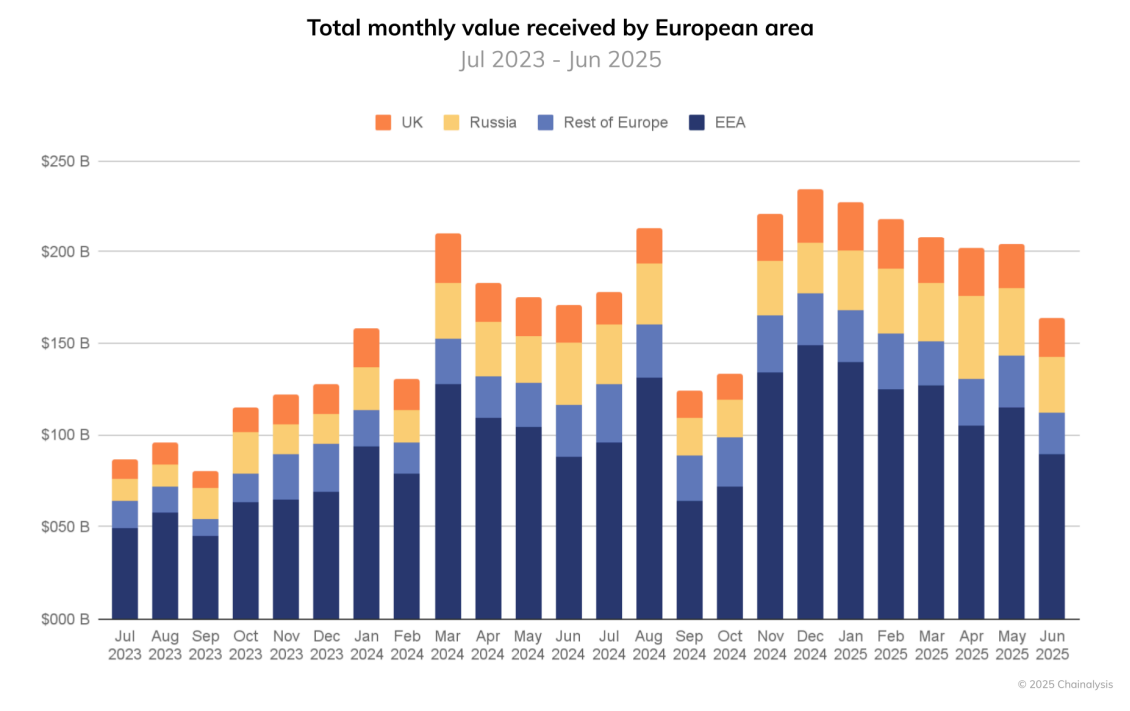 total monthly value received by the European area between July 2023 and June 2025 – Chainalysis data
MiCA regulation transforms the European crypto ecosystem and supports regulated stablecoins
Following its implementation in Europe at the end of 2024, the European crypto ecosystem has moved from a fragmented, AML-focused approach to the world's first unified cryptocurrency framework. MiCA harmonizes rules across the EEA area with the following objectives: Promoting market integrity Strengthening financial stability Protecting consumers Creating a level playing field in the region Restructuring Europe's stablecoin landscape The Chainalysis report shows that the 54% growth of Germany's crypto economy reflects its emergence as a preferred destination for crypto-native firms, attracted by the country's financial infrastructure and the implementation of the MiCA framework. Other countries such as Ukraine and Poland also saw significant growth in their crypto markets, at 52% and 51% respectively. MiCA has also reshaped the stablecoin landscape in Europe – the framework has driven out market leader USDT, while Circle's EURC has grown over 2,700% between July 2024 and June 2025, and USDC is up 86% over the same period. This demonstrates the potential of regulatory-aligned local stablecoins.
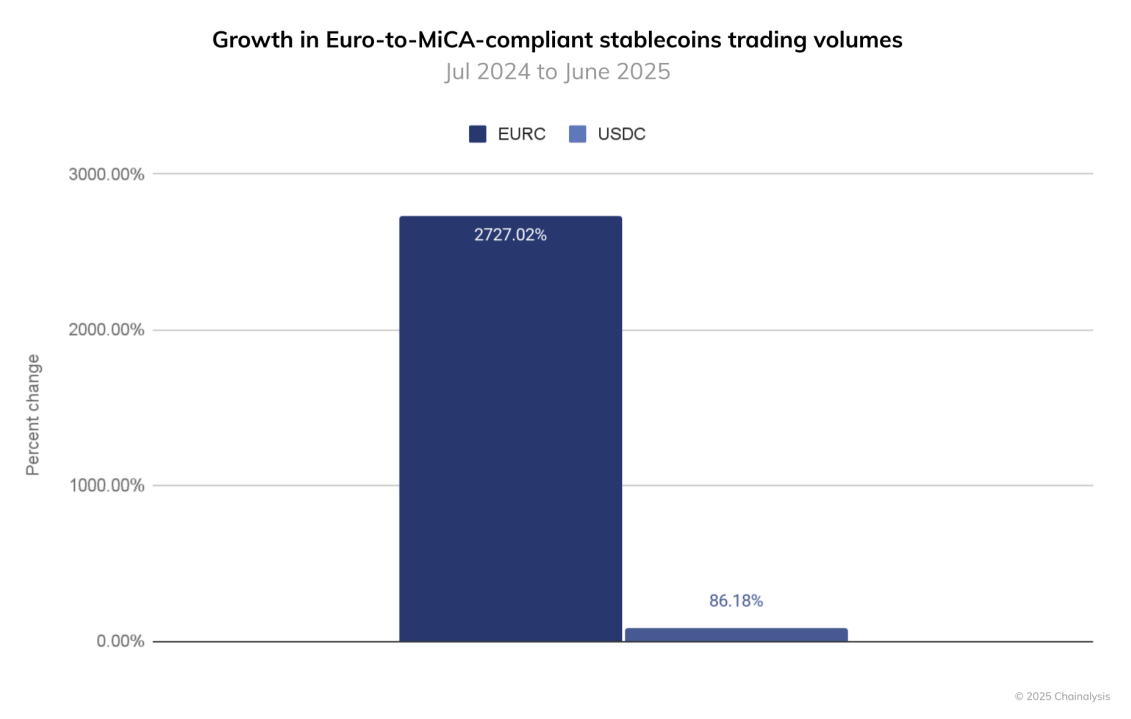 growth in MiCA-compliant euro stablecoin trading volumes between July 2024 and June 2025 – Chainalysis data
DeFi activity in Europe
Chainalysis also analyzed DeFi activity in the region, highlighting its continued evolution, with possible future regulations to address emerging services, including staking and lending. The report identified distinct regional features in different transaction categories: The “bridge” category (transactions that move assets between blockchains) shows 65% higher activity in EEA compared to non-EEA regions, correlated with the stablecoin market adjustment period and increased cross-chain operations on Binance Smart Chain and Polygon. DEX transaction volumes in the EEA showed different patterns compared to non-EEA regions – Russia had increased DEX activity, while EEA countries saw an increase in token contract activity, including the creation and burning of digital assets. Lending activity peaked in May 2025, reflecting user engagement in DeFi services.
Crypto adoption in Romania
The Chainalysis report highlights Romania as one of the most dynamic crypto markets in Europe, with an estimated growth of between 45% and 48% YoY in total trading volume. Romania is part of the EEA region and is described by the platform as an «acceleration zone» – a country where crypto adoption is still expanding, and not in the process of stabilization.
The main growth factors of the crypto market in Romania
The main growth factors of the crypto market in Romania are as follows, according to the report: Remittances – Cryptocurrencies are widely used for cross-border payments, especially by Romanians working in Western Europe. Use of DeFi – A growing number of traders are using DeFi platforms for trading, lending and staking. Stablecoins – The use of euro-backed and MiCA-compliant stablecoins (such as EURC or USDC) is increasing, replacing irregular MiCA stablecoins such as USDT. Technological developments – Romania's solid network of IT specialists and developers supports innovation and early adoption of Web3 tools in the country.
Crypto regulation
Romania now operates under MiCA, and most local crypto exchanges and brokers operate with temporary licenses until 2026. MiCA's clear regulation for cypto is currently attracting more and more fintechs and payment providers interested in services such as custody, tokenization and MiCA-compliant exchange platforms.
Key features of the crypto market in Romania
The Romanian crypto market is currently dominated by retail traders, and most transactions are under $10,000. Institutional activity is gradually increasing, especially in fintech projects associated with the banking sector. Also, the Romanian crypto market is witnessing an increased migration towards DEXs (decentralized platforms/exchanges) and self-custody solutions.
The regional importance of Romania
Romania follows a growth model similar to that of Poland and Ukraine and benefits from full integration within the EU MiCA. Chainalysis describes the country as a bridge between the conformity of Western Europe and the innovation of Eastern Europe – Romania being an emerging hub for the Balkans area and the entire SEE region. Vivien Lin, Chief Product Officer at the BingX exchange, emphasized that Romania has passed the emerging market stage – it is now a key player on the crypto map of Europe. The core features that make Romania special include: Organic growth of the crypto market, with real users and creators Solid technical know-how Romania recorded a YoY growth rate of 50%, higher than the Czech Republic, Hungary, Greece, Moldova, Italy, Spain and others.
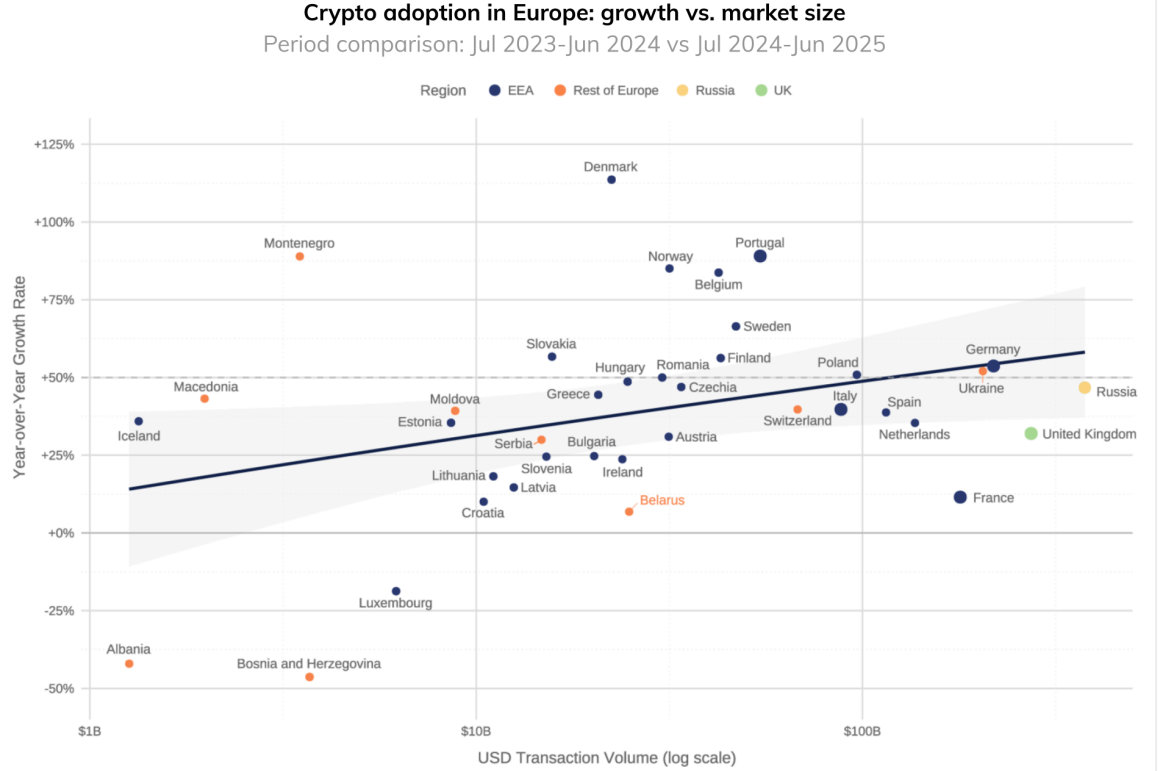 Crypto adoption in Europe – growth vs market share – Chainalysis report Lin believes that as the MiCA framework develops in the region, Romania can become the most agile and compliant crypto hub in Eastern Europe. Romanian users learn quickly and can easily adapt, and this maturity will define the next stage of the crypto market in Europe. BingX will support and accelerate this evolution through education and accessibility, Lin emphasized.