
♦ The NATO summit in Ankara, expected by all, started with scandal and ended with kisses: Article 5 on collective defense was underlined, Russia was defined as a long-term threat, Ukraine will receive 140 billion euros in aid this year and in 2027, and NATO will do everything possible to prevent Iran from possessing nuclear weapons ♦ Romania was represented by President Nicuşor Dan. The American president, Donald Trump, did his usual number. He threatened that, if he wanted to, he could withdraw all American military forces from Europe. On Tuesday, on the first day of the summit, he shouted, in front of the cameras, his dissatisfaction with NATO. He resumed the subject of Greenland, and criticized the Europeans for not giving it to him. He accused Europe of not supporting him in Iran. After accusing NATO of not spending enough and robbing America, he ended by saying that «I don’t need their money», but «loyalty». He didn’t say «obedience», but that’s what he meant. He announced that the US was breaking trade relations with Spain, because the Spanish did not make available its airports in its war in Iran. Yesterday, on the second day of the summit, he calmed down, he didn’t mention Greenland, he didn’t attack Spain and he didn’t say anything about Georgia Meloni, the prime minister of Italy. The final statement does not surprise the tensions within the Alliance. It reiterates that the article on collective defense remains the cornerstone of the alliance («An attack against one of us is an attack against all of us.»), Russia represents a long-term threat, and funding for Ukraine (70 billion euros this year and another 70 billion euros in 2027) is assured. You may also be interested: President Nicuşor Dan, present at the summit, said that he does not see the danger of the US withdrawing from Europe, but he made promises of higher defense spending – 3.7% of GDP for «defense and security» in 2026. What this means, the president did not fully explain, given that the defense budget is 2.4% of GDP for this year.Money, money, money… And yet, money remains the destabilizing element of the alliance. A lot of money is needed. Europe and Canada have gone from NATO spending of $574 billion in 2025 to $634 billion in 2026. That is, they have reached half of the spending that must be done to reach the 5% of GDP goal. At the NATO summit in The Hague last year, NATO leaders (except for Spain) committed to spending 5% of GDP on defense by 2035 (3.5% of GDP on defense itself and 1.5% of GDP on defense-related projects such as dual-use infrastructure, cyber security, etc.), but few states can easily carry out this effort. The previous commitment was for member spending to reach 2% of GDP by 2024. The US is expected to spend 3.17% of GDP on defense in 2026, Germany 2.69%, the UK 2.56% and France 2.22%, according to projections. In total, according to NATO estimates, European member states and Canada will spend 2.53% of GDP on defense this year. Romania should reach, this year, 2.4% of GDP, spending on defense – that is, almost 50 billion lei ($11 billion). It is three times the financial effort of ten years ago. But the effort to reach 5% of GDP will overburden the budget. Spending more on defense than on education At the summit in The Hague in 2025, Mark Rutte, the general secretary of NATO, had asked member states to reach 5% of GDP by 2029. But many countries said they could not bear this effort, and thus the deadline was moved to 2035.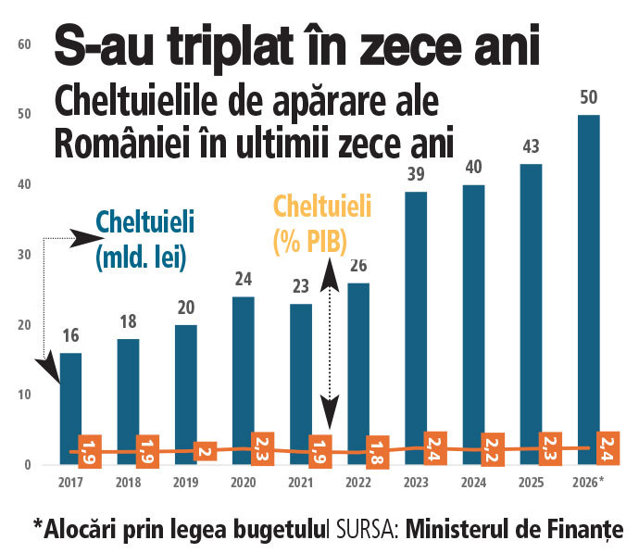 The US blames the European members of NATO for not spending enough. But as a percentage of GDP, the US spends less on defense than other NATO members. It is true that the colossal US economy of 32,000 billion dollars leaves no room for interpretation. Last year, 3% of US defense GDP was $954 billion. A budget two-thirds larger than the expenses of the European states in NATO and Canada, combined. According to the International Peace Research Institute in Stockholm, last year the US had 1/3 of all the world’s defense expenditures, of $2,887 billion. But one thing is even more interesting, namely the defense contribution reported not to GDP, but to the budget revenues of each member state. Thus, the USA spends 13% of its budget revenues on defense. In Russia they approach 50% of income, because the economy was adapted to the state of war. If 5% of GDP is spent on defense, not all countries will bear the burden in the same way, although the percentage is valid for all. According to a study by the Friedrich Ebert Foundation, carried out last year, allocating 5% of GDP to defense would make almost all European NATO member countries, with the exception of Sweden, spend more on defense than on education. For Romania, where budget revenues represented only 34.7% of GDP last year (36% revenue estimates for this year, thanks to EU funds), this commitment would mean redirecting almost 15% of revenues to defense. If the percentage had been applied this year, defense should have received 103 billion lei, compared to the 61 billion lei allocated to education. For comparison, France, with budget revenues of 51% of GDP, would allocate less than 10% of budget revenues to defense. Bulgaria should allocate 13.6% of revenues, the Czech Republic 12%, and the USA 13%, compared to Romania’s 15%. The EU average would be 11%. So, this is how an external obligation will have to modify the internal fiscal behavior. Romania cannot remain with budget revenues of 34-35% of GDP (the EU average being 45% of GDP) because, without money in the budget, it will be forced to cut from other categories of expenses – education, health, social expenses. How it will reach a better collection is a question that has theoretical answers (the involvement of ANAF, automation, electronic invoices, etc.), but which, in practice, has not received an answer for years. The final declaration of the NATO summit: Art. 5 remains standing► We, the heads of state and government of the North Atlantic Alliance, would gather in Ankara to reaffirm our unwavering commitment to collective defense, according to Article 5 of the Washington Treaty, and to the transatlantic relationship. An attack against one of us is an attack against all of us.► To counter Russia’s long-term threat to Euro-Atlantic security and stability and the persistent threat of terrorism, Allies fulfill their Hague defense commitment (5% of GDP for defense by 2035 – ed.)► European Allies and Canada, in collaboration with the United States, assume greater responsibility for the defense of the alliance. NATO’s deterrence and defense is based on an appropriate mix of nuclear, conventional and missile defense capabilities, complemented by space and cyber resources.► Ukraine contributes to transatlantic security, and some allies maintain unwavering support for Ukraine in defense of its freedom, sovereignty and territorial integrity. (…) For 2026, the Allies pledge to provide 70 billion euros in military equipment, assistance and training to Ukraine and reaffirm their sovereign commitments to maintain at least equivalent levels in 2027. ► The Allies reiterate that Iran must never possess a nuclear weapon and demand that Iran fully respect freedom of navigation in the Strait of Hormuz. Who gives more?► $954 billion was US defense spending in 2025► $574 billion were the defense expenditures, within NATO, of Europe and Canada, in 2025 ($634 billion expected expenditures for 2026)► $336 billion was China’s defense spending in 2025► $190 billion was Russia’s defense spending in 2025SOURCE: Stockholm International Peace Research Institute
For other news, analyses, articles and business information in real time, follow NV on WhatsApp Channels