
Women and youth in power! Forbes magazine published its annual “30 Under 30 Europe” ranking on April 14, highlighting young founders and researchers whose activity now influences economic and scientific structures. This edition highlights a clear trend: the growing integration of artificial intelligence and decentralized technologies in traditional sectors such as health or industrial research. While fundraising in technology sectors reached $5.6 billion in the first quarter of 2026 according to Messari data, these young leaders are capturing a notable share of this capital to finance operational solutions.
The key points of this article:Forbes has published its “30 Under 30 Europe” ranking, revealing the rise of young innovators in health and research, thanks to AI and decentralized technologies.
Entrepreneurs like Angelica Iacovelli and Batuhan Yumurtacı transform complex algorithms into concrete solutions, demonstrating an ability to raise significant funds for crucial innovations.
Forbes ranking: Artificial intelligence in the service of research and health
The analysis of the profiles selected by the Forbes teams reveals a pragmatic use of artificial intelligence to resolve diagnostic and productivity issues. In the medical sector, Angelica Iacovelli, founder of Nucleo Research, has developed agents that can automatically extract critical data from CT scanners. This innovation reduces interpretation time for radiologists and accelerates the care of cancer patients. In a comparable way, Benjamin Tenmann and Lorenzo Sani, through their ScienceMachine platform, automate repetitive manual tasks related to research and developmenta tool now used by thousands of scientists to optimize their protocols. This dynamic also extends to robotics and defense with Carla Gómez Cano and Jiaqiang Ye Zhu, via Theker Robotics who design AI-powered automatons to improve industrial assembly. In a different register, Batuhan Yumurtacı founded Tytan Technologies, specializing in anti-drone systems. These projects demonstrate that the added value of the new generation lies in its ability to transform complex algorithms into concrete hardware tools, meeting immediate security and industrial efficiency needs. The ranking also illustrates the convergence between digital assets and service platforms. Alexandre Rouxel, co-founder of Plai Labs, illustrates this trend by mixing the mechanisms of Web3 to artificial intelligence. While these technologies enable new digital ownership models, they also serve as the basis for more transparent ecosystems.
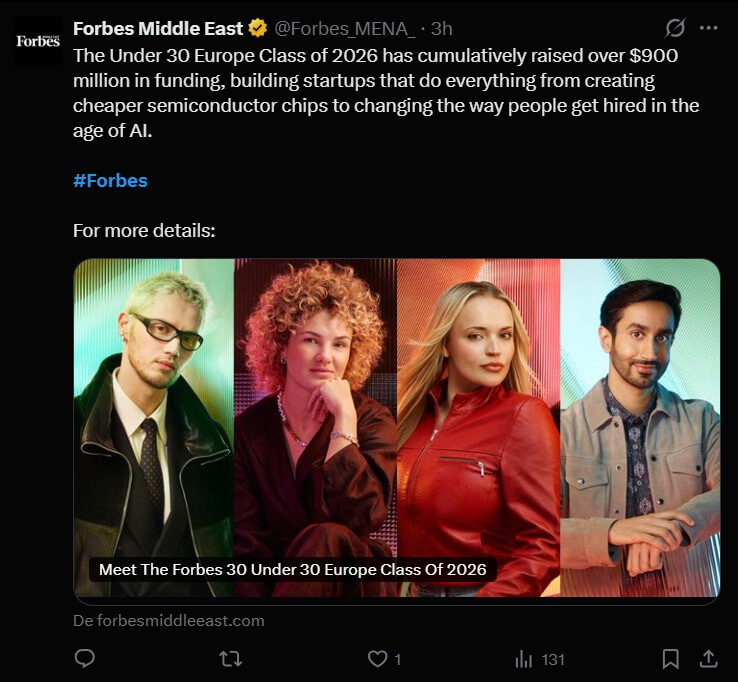 Fornes publishes its 30 under 30 special Europe ranking – Source: Compte
Web3 and connected health: Towards personalization of services
In parallel, female entrepreneurship stands out in the field of FemTech and personalized health. Felicia von Reden, co-founder of Ovom Care, uses data to optimize fertility journeys, while Olivia and Chloe Ferro have propelled SheMed to unicorn status with a billion-dollar valuation. This success is based on a telemedicine platform specialized in supporting GLP-1 treatments, targeting pathologies such as polycystic ovarian syndrome. With more than 80,000 patients, the company combines prescription and therapeutic monitoring, proving that digital monitoring can overcome certain shortcomings of traditional health systems. Finally, initiatives like Mindstep, led by Aaron Lin and Hamzah Selim, are transforming smartphones as neurological screening tools via eye movement tracking. These advances demonstrate a decentralization of care, where technology allows proactive and autonomous health monitoring. Forbes' selection for the year 2026 confirms that young European entrepreneurs are no longer limited to the creation of isolated software. They are now building hybrid infrastructures where computer code meets medical equipment and industrial systems. The ability of these players to raise massive funds in a context of increased regulation shows a certain maturity of the European technological ecosystem. The sustainability of these companies will depend on their ability to maintain this pace of innovation while ensuring data security and the reliability of automated diagnostics. This generation, however, seems to have already succeeded in imposing the use of artificial intelligence as a an essential standard of modern economic performance.