
Gen Z is betting on the future. While traditional finance is losing steam among younger generations, a new phenomenon explodes: prediction markets. According to a recent study by The New Consumer and Coefficient Capital, a third of Americans — with a massive concentration among Gen Z and Millennials — are convinced that these platforms will become a major cultural force. Buoyed by a more flexible regulatory framework in the United States, the giants Kalshi and Polymarket now weigh a combined total of $20 billion.
The key points of this article:Gen Z and Millennials have embraced prediction markets, seeing them as a major cultural force.
Kalshi and Polymarket have achieved spectacular valuations, supported by colossal investments and favorable regulation.
A generational divide and record volumes
The interest in prediction markets does not affect all age groups in the same way, as highlighted in our study today. We observe a real digital divide: 17 % young adults know Polymarketagainst only 4 % among those over 45. And this new notoriety translates into dizzying financial flows.
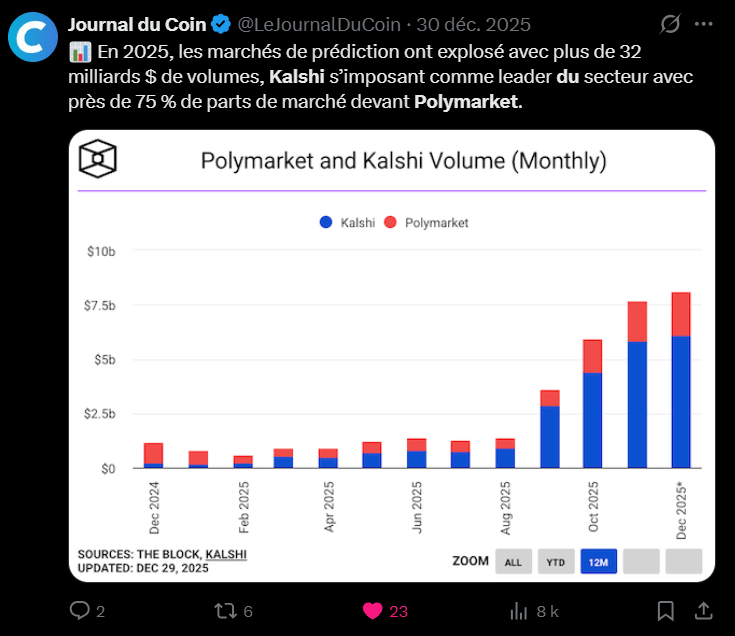
Kalshi now processes between $1.7 billion and $2.3 billion per week, while Polymarket follows closely behind with weekly volumes regularly exceeding $1 billion. This dynamic is also supported by investments institutional massive. The Intercontinental Exchange (owner of the New York Stock Exchange) recently injected $2 billion into Polymarketvaluing the platform at 9 billion. For his part, Kalshi raised $1 billion at a valuation of $11 billion. For these investors, it is no longer a simple electoral gimmick, but a infrastructure data predictive able to compete with traditional surveys.
 Americans love predictive markets and particularly young people – Source: Compte
Regulation and the future: Towards a merger with the real economy
The takeoff of these platforms owes much to a change of tone in Washington. Under the direction of Michael Seligthe CFTC took a pragmatic approach, allowing Polymarket to return to American soil at the end of 2025 with an official blessing. At the same time, the legal victory of Kalshi in May 2025 paved the way for markets on elections federal, despite the resistance of some regulators locals fearing head-on competition with sports betting. The challenge now is to know whether these markets can anchor themselves sustainably in the daily. Today, 31 % of young Americans place the cultural importance of food markets prediction at the same level as that of betting sportsmen. The next big test will be the 2026 FIFA World Cup: with $35 billion in expected stakes, the markets prediction will have to prove that they are financial tools serious of risk management and not a simple speculative bubble. Prediction markets are no longer a niche for statistics enthusiasts; they become the barometer of truth for a generation that distrusts traditional media. By transforming each global event into a tradable asset, Kalshi and Polymarket are redefining our relationship with information. If the trend up and to the right [courbe ascendante] is confirmed, these platforms could well become, by the end of the decade, the most reliable sources of information on the global economy.